Warehouse daylighting India | Warehousing lighting solutions | Logistics hub skylight | eView Global
Walk into a large warehouse anywhere in India at 10 in the morning and you will likely see the same thing: rows of high-bay LED fittings burning at full power, casting flat artificial light across racks, aisles, and loading bays while outside, the sun is pouring down with more than enough energy to illuminate the entire building several times over. Nobody in that warehouse is thinking about it as waste. It is simply how warehouses work.
That assumption is costing Indian warehouse operators and logistics businesses millions of rupees every year unnecessarily. Today, a well-engineered natural daylighting installation in a large-format Indian warehouse eliminates the need for artificial lighting during all daytime operational hours across the majority of the floor area. The technology is proven, the ROI is documented, and the installation is less disruptive than most facility managers expect.
Why Warehouses Are the Ideal Candidate for Natural Daylighting
- Large roof areas relative to floor area. A warehouse’s wide, unobstructed roof span offers extensive surface area for daylighting panel installation, with a direct and largely unobstructed line between roof and floor.
- Daytime-dominant operations. Most warehouse and logistics operations run heavily across daylight hours – receiving, picking, packing, dispatch, and inventory management – maximising hours where natural daylighting can replace artificial lighting entirely.
- High lighting loads. Large warehouses require significant light output to maintain safe lux levels across wide floor areas and tall racking systems, making the saving from replacing artificial lighting proportionally large.
- Simple, open interiors. The absence of false ceilings and complex partitioning means that daylighting panels in the roof deliver light directly to working floor level without obstruction.
The Real Cost of Artificial Lighting in Indian Warehouses
A straightforward analysis for a 1,00,000 square foot logistics warehouse illustrates the scale:
- 200 fittings averaging 175W = 35 kW total lighting load
- 35 kW x 10 hours x 300 days x ₹8.50 per kWh = ₹8,92,500 per year
Nearly nine lakh rupees annually. In a single facility. On lighting alone. For a logistics company operating five or ten warehouses across India, the aggregate annual lighting spend runs into crores.
Furthermore, electricity tariffs in industrial and commercial zones continue to rise a spend of nine lakh rupees today will be ten to eleven lakhs within three to four years at current escalation rates.
How Warehouse Daylighting Solutions Work
Modern warehouse daylighting solutions are not the same as installing transparent roof sheets. Old transparent sheet installations admitted heat along with light and degraded within five to eight years. Modern solutions solve both problems through diffusion technology and engineered panel construction.
Brilantor Daylighting Panels
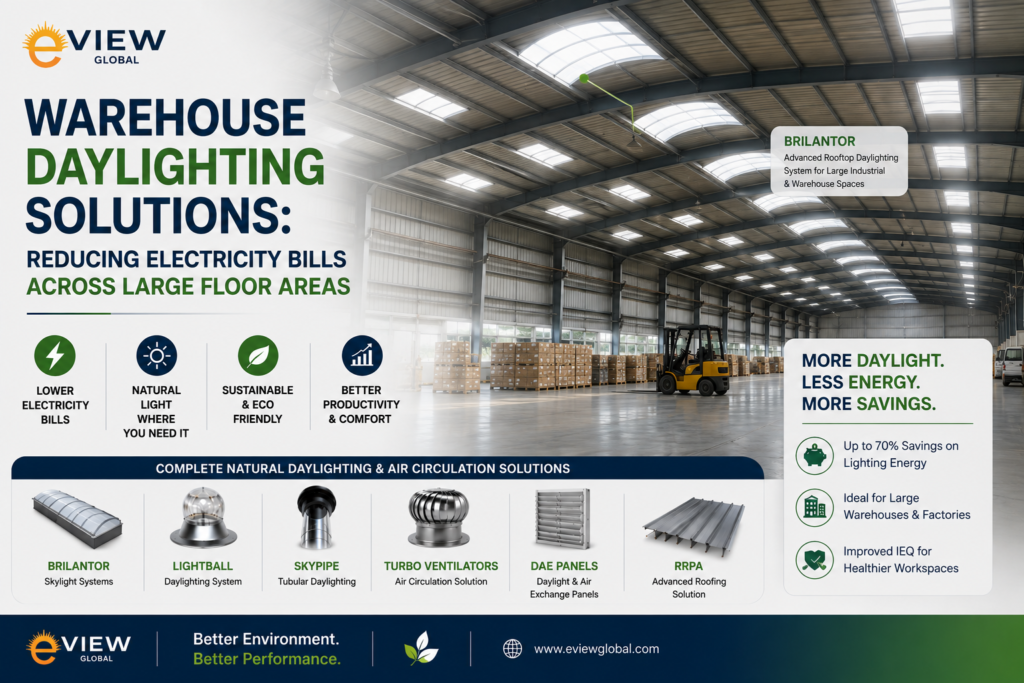
Brilantor is eView Global’s flagship daylighting system and the most widely deployed solution for large-span warehouse roofs. Brilantor panels use a multi-layer construction that separates visible light transmission from infrared heat transmission scattering incoming sunlight evenly across the floor area below while blocking the solar heat that makes conventional transparent sheets problematic. The result is bright, even, glare-free natural illumination at floor level, meeting BIS IS 3646 lux requirements for warehousing operations without the heat gain penalty. Service life exceeds 20 years with consistent light transmission maintained throughout.
LightBall Dome Diffusers
For warehouses where the preference is for point-source daylighting discrete dome units rather than continuous panel strips – LightBall dome diffusers provide an alternative. Each LightBall unit captures sunlight from a hemispherical dome and diffuses it evenly into the space below, providing consistent illumination regardless of sun angle throughout the day. LightBall units suit warehouses with existing metal roofing where strip panel installation is not structurally feasible, or where incremental phased installation is preferred.
SkyPipe Tubular Skylights for Enclosed Zones
Large logistics hubs include enclosed zones offices, security cabins, quality control rooms, temperature-controlled annexes that cannot receive light from conventional roof panels. SkyPipe tubular skylights channel daylight from a rooftop collector dome down through a reflective tube into the interior space below, regardless of ceiling height or offset from the main roof plane, extending daylighting coverage into every enclosed space within the facility.
Designing for Large Floor Areas: The Coverage Calculation
- Panel-to-floor ratio: For a standard warehouse with a roof height of 8 to 12 metres and a target floor lux of 150 to 200, a panel-to-floor ratio of approximately 5% to 8% is typically required for effective daylighting coverage.
- Roof height and panel spacing: Higher roofs diffuse light more broadly from each panel, allowing wider spacing between units. Lower roofs require closer spacing to avoid dark zones between panels.
- Obstructions and racking systems: Tall racking can create shadow zones at floor level. A proper daylighting design accounts for racking layout, height, and aisle orientation to ensure lux targets are met at operative working level.
- Orientation and climate zone: A warehouse in Chennai receives significantly different solar irradiance profiles than one in Chandigarh. The daylighting design accounts for local solar geometry and seasonal variation.
The Savings Calculation for a Large Warehouse
Applying realistic daylighting coverage to the 1,00,000 square foot example with a Brilantor installation covering 75% of the floor area:
- Lighting load reduced from 35 kW to approximately 8.75 kW
- Annual consumption reduced from 1,05,000 kWh to approximately 26,250 kWh
- Annual electricity saving: 78,750 kWh x 8.50 = ₹6,68,875 per year
- Simple payback at mid-range installation cost of ₹23 lakhs: 3.4 years
- Total lifetime saving at current tariffs over 20 years: approximately ₹1.07 crore
Beyond Electricity: The Other Business Case for Warehouse Daylighting
- Worker accuracy and safety. Picking accuracy, forklift operation safety, and label reading reliability all improve under natural light conditions. Research consistently shows that natural light reduces error rates and improves sustained concentration – measurable value in any high-volume logistics operation.
- ESG and sustainability reporting. Eliminating 78,750 kWh of annual electricity consumption reduces Scope 2 carbon emissions by approximately 56 tonnes of CO2 equivalent per year in a single 1,00,000 square foot facility a documented and verifiable emission reduction that strengthens annual BRSR sustainability disclosures.
- Green building certification. IGBC Green Factory Building and LEED certifications for logistics facilities confer commercial advantages – preferential land allocation, access to green bonds, and differentiation when pitching to ESG-conscious clients. Warehouse daylighting directly contributes to the certification score in both frameworks.
- Reduced heat load. Switching off artificial lighting during the day removes the heat generated by those fittings complementing natural ventilation from turbo ventilators and DAE Panels, and reducing mechanical cooling runtime in temperature-managed zones.
What to Look for When Evaluating a Warehouse Daylighting Solution
- Site-specific lux calculations, not rule-of-thumb panel counts. A credible proposal should include floor-level lux projections at multiple points across the warehouse layout.
- Heat transmission data for the proposed panel system. Any vendor unwilling to provide infrared heat transmission specifications is selling a product, not a solution.
- Installation track record in similar building types. A vendor with 1,540+ completed installations across Indian industrial and logistics facilities is a fundamentally different proposition from one with a catalogue and a subcontracted installation team.
- Post-installation performance guarantee. Projected lux levels and light transmission performance should be backed by a credible service commitment.
The Starting Point
The sunlight falling on your warehouse roof right now is free. Every hour your artificial lights run during daylight hours is money paid for something nature is providing at no cost. The investment required to capture that value is modest relative to the lifetime return. The technology is proven across thousands of Indian facilities. And the payback period – three to four years in most cases is well within the threshold of any standard capital investment appraisal.