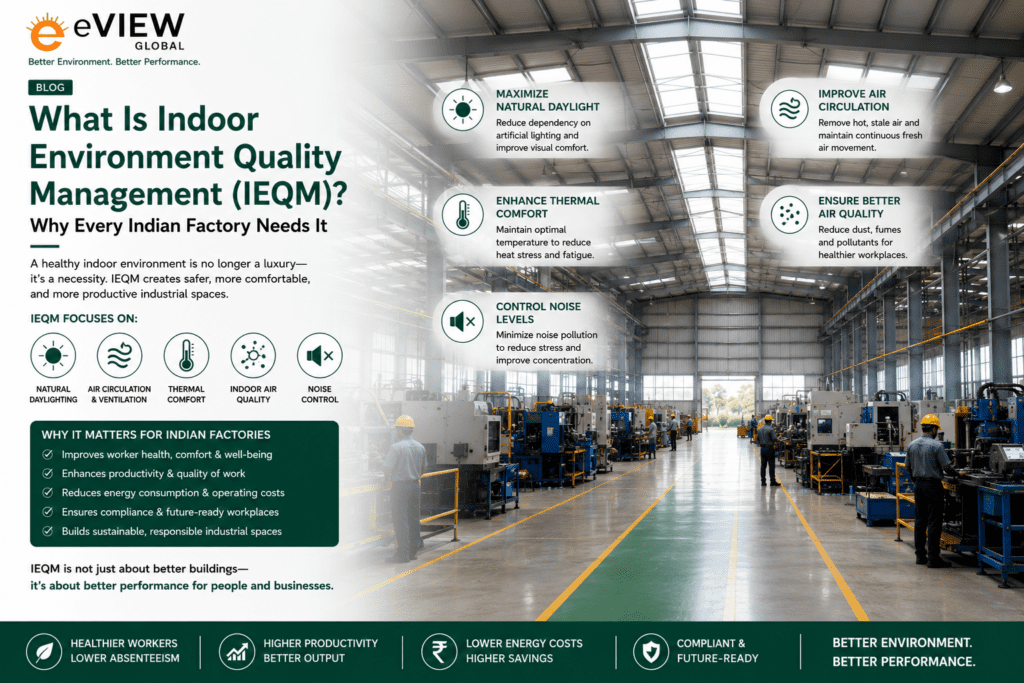
Industrial buildings are designed to support machines, production lines, storage systems, and operational workflows. But in many factories across India, one critical aspect is often overlooked — the quality of the environment inside the building itself.
Workers spend long hours inside industrial spaces exposed to excessive heat, stale air, suspended airborne particles, industrial fumes, poor ventilation, and harsh artificial lighting. Over time, these conditions reduce productivity, increase operational costs, impact worker wellbeing, and create long-term environmental challenges.
This is where Indoor Environment Quality Management (IEQM) becomes essential.
At eVIEW Global Pvt. Ltd, Indoor Environment Quality Management is approached as a complete environmental engineering strategy that combines natural daylighting, air circulation, thermal management, air exchange, and sustainable rooftop systems to create healthier, safer, and more energy-efficient industrial buildings.
What Is Indoor Environment Quality Management (IEQM)?
Indoor Environment Quality Management (IEQM) refers to the process of improving and maintaining the internal environmental conditions of a building to support:
- Human health and comfort
- Better Indoor Air Quality Index (IAQI)
- Improved productivity
- Reduced energy consumption
- Sustainable industrial operations
IEQM is not just about ventilation or lighting individually. It is the integration of multiple environmental factors working together inside a building.
A complete IEQM strategy typically includes:
- Natural daylighting systems
- Air circulation and air exchange
- Thermal comfort management
- Reduction of suspended particles and fumes
- Sustainable building materials
- Reduced dependence on artificial industrial lighting
For industrial buildings in India, IEQM is becoming increasingly important because factories today are expected to meet both operational efficiency goals and environmental sustainability standards.
Why Indoor Environment Quality Matters in Indian Factories
Most Indian industrial facilities face similar environmental problems:
Heat buildup below metal roofs
Poor air circulation
Dust accumulation and suspended particles
Industrial fumes and stale air
Excessive reliance on artificial lighting
High electricity consumption
Worker fatigue and discomfort
These issues directly affect:
- Worker health
- Operational efficiency
- Equipment performance
- Energy bills
- Carbon footprint
- Long-term maintenance costs
According to studies on indoor air quality in industrial environments, poor ventilation and airborne pollutants significantly affect employee health, respiratory safety, and productivity.
Understanding IAQI (Indoor Air Quality Index)
One of the most important components of IEQM is IAQI — Indoor Air Quality Index.
IAQI measures the quality of air inside a building by evaluating pollutants such as:
- PM2.5 and PM10 suspended particles
- Dust and airborne contaminants
- Volatile Organic Compounds (VOCs)
- Industrial fumes
- Carbon dioxide concentration
- Humidity and stale air buildup
Industrial facilities with poor IAQI often experience:
- Reduced worker concentration
- Respiratory discomfort
- Eye irritation and fatigue
- Sick Building Syndrome
- Lower operational productivity
Research shows that inadequate ventilation allows pollutants and airborne particles to accumulate inside buildings, increasing health risks for occupants.
In Indian industrial environments, this becomes even more critical because manufacturing processes continuously generate heat, dust, fumes, and suspended contaminants.
Suspended Particles, Fumes & Stale Air: The Hidden Industrial Challenge
In many factories and warehouses, the biggest environmental risks are often invisible.
Processes such as:
- welding
- cutting
- grinding
- chemical processing
- packaging
- material movement
continuously release suspended air particles and industrial fumes into the internal environment.
Without proper air exchange and circulation systems, these pollutants remain trapped inside the building for long periods.
Studies on industrial indoor air quality show that suspended particles can contribute to respiratory problems, fatigue, and long-term occupational health risks.
Stale air also creates:
- uncomfortable working conditions
- heat retention
- moisture buildup
- unpleasant odors
- reduced oxygen circulation
This is why modern factories are increasingly shifting toward passive and sustainable environmental systems instead of relying only on conventional mechanical cooling and artificial ventilation.
The Role of Natural Daylighting in IEQM
Natural daylighting is one of the core pillars of Indoor Environment Quality Management.
Unlike conventional artificial industrial lighting, natural daylight provides balanced full-spectrum illumination that supports:
- visual comfort
- reduced eye strain
- improved alertness
- better workplace productivity
Research on indoor environmental conditions consistently shows that humans perform better under natural light conditions compared to artificial lighting alone.
At eVIEW Global, natural daylighting solutions such as:
- Brilantor Daylighting Systems
- LightBall Systems
- SkyPipe Tubular Skylights
- Passive Daylighting Systems (RRPA)
help industrial buildings reduce daytime electricity consumption while improving the indoor working environment.
Natural daylighting also supports:
- daylight harvesting
- lower carbon emissions
- reduced operating costs
- sustainable infrastructure goals
Air Circulation & Air Exchange: Essential for Healthy Industrial Buildings
IEQM is incomplete without effective air circulation.
Air circulation systems are responsible for:
- removing trapped heat
- exchanging stale indoor air
- improving IAQI
- reducing humidity buildup
- supporting thermal comfort
Passive rooftop ventilation systems such as:
- Turbo Ventilators
- Roof Air Ventilators
- Daylighting & Air Exchange Panels
help continuously move hot air and pollutants out of the building without heavy electricity consumption.
This becomes especially important in:
- warehouses
- manufacturing plants
- logistics centers
- foundries
- fabrication facilities
- food processing units
where air quality and heat buildup directly affect operational conditions.
IEQM Helps Reduce Operating Costs
One of the biggest advantages of Indoor Environment Quality Management is operational efficiency.
Factories implementing IEQM strategies often experience:
- reduced lighting costs
- lower HVAC dependency
- improved thermal comfort
- lower maintenance expenses
- reduced energy consumption
Natural daylighting reduces dependency on industrial lighting during daytime operations, while passive air circulation systems reduce the need for powered ventilation.
This directly supports:
- decarbonization goals
- ESG initiatives
- sustainability targets
- environmental compliance
As industrial energy costs continue rising in India, IEQM is becoming not just an environmental decision — but a business necessity.
Why IEQM Is the Future of Indian Industrial Infrastructure
Modern industrial buildings are no longer judged only by production output.
Today, businesses are also evaluated based on:
- worker wellbeing
- environmental responsibility
- sustainability performance
- energy efficiency
- indoor environmental quality
Factories that fail to improve internal environmental conditions may face:
- higher operational costs
- lower workforce efficiency
- increased maintenance issues
- growing sustainability pressures
Indoor Environment Quality Management provides a long-term solution by integrating:
- natural daylighting
- air circulation
- thermal management
- indoor air quality improvement
- sustainable rooftop systems
into one unified environmental strategy.
How eVIEW Global Supports IEQM in India
eVIEW Global Pvt. Ltd specializes in Indoor Environment Quality Management solutions for industrial and commercial buildings across India.
The company’s environmental systems are designed to improve:
- Natural Daylighting
- Air Exchange
- IAQI
- Thermal Comfort
- Energy Efficiency
- Sustainable Building Performance
Its solution ecosystem includes:
- Brilantor Daylighting Systems
- LightBall Natural Daylighting
- SkyPipe Tubular Skylights
- Turbo Ventilators
- Daylighting & Air Exchange Panels
- RRPA Passive Daylighting Systems
With over 1,540+ completed projects, eVIEW Global focuses on creating industrial environments that are healthier, brighter, and more sustainable.
Conclusion
Indoor Environment Quality Management is no longer optional for modern industrial buildings.
As Indian factories continue evolving toward energy efficiency, sustainability, and healthier workspaces, the focus is shifting beyond production alone toward the quality of the internal environment itself.
By integrating:
- natural daylighting
- air circulation
- air exchange
- thermal management
- IAQI improvement
industrial facilities can significantly improve worker comfort, operational efficiency, and long-term sustainability.
The future of industrial infrastructure is not just about buildings that function — but buildings that actively support the people working inside them every day.
Build Healthier Industrial Environments with eVIEW Global
Transform your industrial building with advanced Indoor Environment Quality Management solutions designed for natural daylighting, air circulation, thermal comfort, and healthier indoor environments.
Request a Consultation Explore Solutions