Natural ventilation vs mechanical ventilation | Industrial ventilation India | Turbo ventilator vs exhaust fan | eView Global
Every factory operator dealing with heat eventually faces a ventilation decision. Two broad options sit on the table: natural ventilation passive systems driven by wind and thermal buoyancy or mechanical ventilation powered fans, exhaust systems, and forced-air equipment driven by electricity. This blog puts both approaches through a rigorous, honest comparison grounded in the operating realities of Indian industrial facilities, Indian electricity tariffs, and the commercial pressures facing Indian manufacturers in 2025 and beyond.
Understanding the Two Approaches
What Natural Ventilation Is
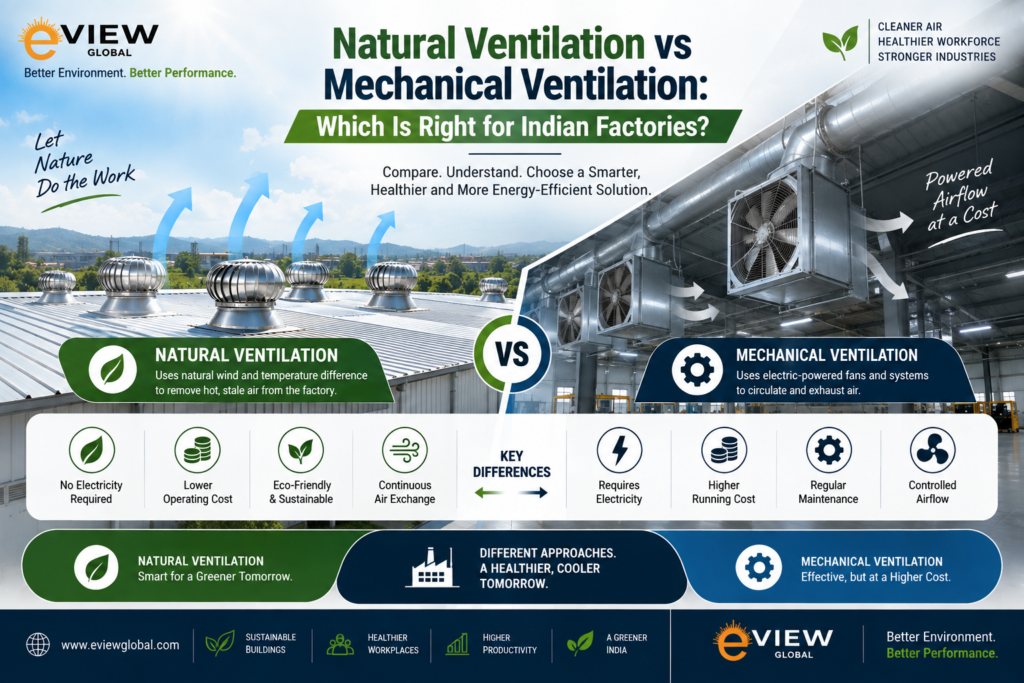
Natural ventilation uses two physical forces – wind pressure and thermal buoyancy to move air through the building without electrical energy. Turbo ventilators at the roof ridge expel hot air using wind-driven rotation and the natural tendency of hot air to rise. DAE Panels at wall and eave level provide the air inlet pathway through which cooler ambient air enters. The result is a continuous, self-regulating convection cycle that operates 24 hours a day at zero electrical cost – running harder when most needed on hot, still afternoons when the temperature differential is greatest.
What Mechanical Ventilation Is
Mechanical ventilation uses electrically powered equipment industrial exhaust fans, centrifugal blowers, evaporative coolers, or ducted forced-air systems to move air. Mechanical systems offer precise airflow control, but this precision comes at a cost: continuous electricity consumption, regular maintenance requirements, defined component service lives, and operational costs that escalate indefinitely.
The Comparison: Seven Dimensions That Matter
1. Energy Consumption and Electricity Cost
Natural ventilation: Zero electricity consumption for the entire 15 to 20-year service life. Mechanical ventilation: Continuous electricity consumption. A factory running 10 industrial exhaust fans at 1.5 kW each across 10 hours a day, 300 days a year, consumes 45,000 kWh annually ₹3,82,500 per year at ₹8.50 per unit. At 6% annual tariff escalation, the 10-year cumulative electricity cost exceeds ₹50 lakhs. Natural ventilation cost: ₹0. Every year. For 20 years.
2. Installation Cost
Mechanical ventilation has lower upfront costs. Natural ventilation turbo ventilators and DAE Panels for a medium industrial facility typically costs ₹8 to ₹20 lakhs. However, with zero operational cost, the payback through electricity savings is typically 2.5 to 4 years, after which the system generates ongoing financial return for the remaining 15+ years of its service life.
3. Maintenance Requirements
Natural ventilation: Minimal. Annual inspection and periodic bearing lubrication. No electrical components to fail, no filters to replace, no ducting to clean. Mechanical ventilation: Significant and ongoing motor maintenance, belt replacement, pad replacement in evaporative coolers, periodic duct cleaning. Aggregate annual maintenance cost: ₹50,000 to ₹2,00,000 depending on system type and scale.
4. Performance in Indian Climate Conditions
Natural ventilation performs effectively across India’s industrial climate zones. The temperature differential between a poorly ventilated factory interior and outdoor ambient – often 10°C to 15°C creates powerful thermal buoyancy forces even on the calmest summer days. Moreover, the stack effect is strongest precisely when heat stress is worst – on still, hot afternoons. Evaporative cooling, the most common mechanical alternative, loses effectiveness as relative humidity rises above 70% making it unreliable during India’s monsoon months when natural ventilation continues to function effectively.
5. Carbon Footprint and ESG Compliance
Natural ventilation generates zero Scope 2 carbon emissions. Mechanical ventilation generates emissions proportional to electricity consumption. The 10-unit fan example above generates 31,950 kg CO₂e – nearly 32 tonnes of carbon per year. Over 20 years: more than 600 tonnes of cumulative Scope 2 emissions – material in BRSR disclosures, CDP submissions, and supply chain audits from international buyers. Natural ventilation earns direct credits in GRIHA, LEED, and IGBC Green Factory Building frameworks. Mechanical ventilation earns none under passive design criteria.
6. Noise and Workplace Environment
Natural ventilation: Silent operation – the low, unobtrusive sound of wind passing through the rotor assembly, functionally inaudible against an industrial facility’s ambient noise floor. Mechanical ventilation: Industrial exhaust fans and blowers generate 65 to 85 dB at 1 metre distance, adding to the documented occupational noise exposure burden on the workforce throughout the shift.
7. System Lifespan and Replacement Cycles
Natural ventilation: 15 to 20-year system life for turbo ventilators with rotor bearing replacement as the primary intervention. DAE Panels are fully passive with no wearing components. Mechanical ventilation: Industrial fan motors last 8 to 12 years under continuous operation. Evaporative cooler pads require replacement every 2 to 4 years. Complete system overhaul or replacement within a 20-year facility life is typical, adding capital reinvestment to the ongoing operational cost burden.
When Mechanical Ventilation Is the Right Answer
A rigorous comparison requires honesty about where mechanical ventilation genuinely outperforms natural alternatives:
- Process-specific fume and contaminant extraction where industrial processes generate chemical vapours, welding fumes, or toxic airborne contaminants requiring targeted source extraction, mechanical LEV is the correct solution
- Cleanroom and controlled environment manufacturing – GMP pharmaceutical, semiconductor fabrication, and similar processes require precise positive pressure control and HEPA filtration that passive systems cannot deliver
- Deep interior spaces with no roof access sub-basement facilities and internal rooms with no roofline exposure cannot use roof-mounted natural ventilation
- 24-hour operations in zero-wind, high-humidity coastal locations consistently still air and very low overnight temperature differentials may require mechanical supplementation
The Integrated Approach: Natural as the Base, Mechanical as the Supplement
The most commercially rational approach for most Indian factories is a layered strategy: natural ventilation as the primary thermal management system, with targeted mechanical ventilation as a supplement only where specific requirements demand it. Turbo ventilators and DAE Panels handle building-wide heat expulsion and air quality at zero electricity cost. Mechanical local exhaust handles source-specific fume extraction at defined process points. Natural daylighting through Brilantor panels, LightBall dome diffusers, or SkyPipe tubular skylights eliminates the artificial lighting heat load. And RRPA composite roofing provides the thermally efficient, corrosion-resistant structural base supporting all systems across their full service life.
This integrated approach the Indoor Environmental Quality Management system that eView Global designs and installs consistently delivers Indian factory environments within 3°C to 5°C of outdoor ambient temperature, naturally daylit during operational hours, and maintained at 10 to 20 air changes per hour of fresh air circulation. All at a fraction of the ongoing operational cost of a mechanically ventilated alternative.
The Commercial Verdict
For Indian factory operators choosing between natural and mechanical ventilation, the comparison resolves clearly in most cases. Natural ventilation costs more upfront, delivers comparable or superior thermal performance, generates zero operational electricity cost, requires minimal maintenance, contributes zero Scope 2 carbon emissions, and operates for 15 to 20 years without replacement. Mechanical ventilation costs less upfront, generates ongoing and escalating electricity costs, requires regular maintenance and eventual replacement, and contributes measurable carbon emissions every year.
The payback calculation on electricity savings alone typically justifies natural ventilation within three to four years. After payback, natural ventilation generates positive commercial return every year for the remaining system life. Mechanical ventilation generates a cost every year, indefinitely. For the majority of Indian factories and warehouses dealing with solar heat gain and general thermal comfort, the answer is natural ventilation by a clear and compounding margin.