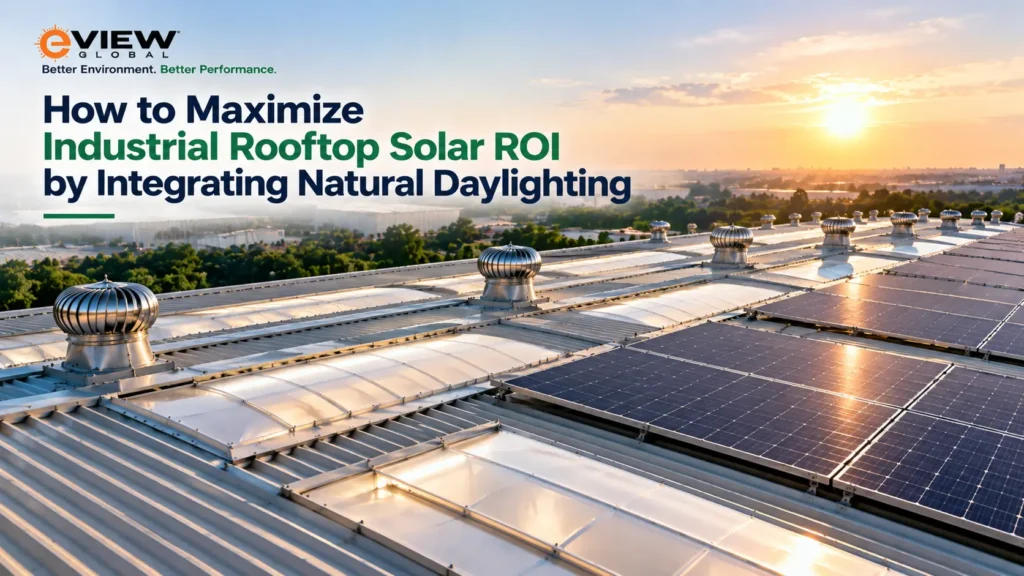
How to Maximize Industrial Rooftop Solar ROI by Integrating Natural Daylighting
Industrial electricity costs can significantly affect manufacturing expenses, warehouse operations, and overall business profitability. As factories look for practical ways to reduce energy consumption, rooftop solar has become an important part of industrial energy planning. However, solar panels are only one part of the opportunity.
Combining industrial rooftop solar with natural daylighting can help businesses reduce electricity purchased from the grid while also lowering the need for artificial lighting during daylight hours.
When both systems are planned together, factories and warehouses can make better use of their roof space, improve energy efficiency, and develop a more comprehensive approach to managing operating costs.
For industrial facilities with large roof areas and long daytime operating schedules, this integrated strategy deserves careful consideration.
In this guide, we explain how to maximize industrial rooftop solar ROI, how natural daylighting contributes to energy savings, and which technical and financial factors businesses should evaluate before investing.
Why Industrial Rooftop Solar ROI Matters More Than Ever
Rooftop solar adoption is growing in India as commercial and industrial businesses explore ways to manage electricity costs and improve energy performance.
According to Mercom India’s Q2 and first-half 2026 market report, India added 3.8 GW of rooftop solar capacity in Q2 2026, bringing first-half additions to 6.6 GW. Industrial installations accounted for approximately 10% of Q2 additions, while commercial installations contributed around 5%.
These figures indicate continued activity in the rooftop solar market, although they do not guarantee a particular return for any individual factory. Actual project economics depend on electricity tariffs, consumption patterns, system costs, regulations, roof conditions, and solar generation.
For factory owners, the important question is not simply how much solar power a rooftop can generate. It is how effectively the facility can use that energy and reduce its overall electricity expenditure.
This is where natural daylighting can complement solar energy.
What Is Industrial Rooftop Solar ROI?
Industrial rooftop solar return on investment (ROI) describes the financial benefit a business receives from investing in a solar installation relative to its cost.
The return depends on factors such as:
- The installed cost of the solar system.
- The amount of electricity generated annually.
- The proportion of generated electricity consumed on-site.
- The electricity tariff and applicable charges.
- The value of surplus electricity exported to the grid, where permitted.
- Operation, maintenance, financing, and replacement costs.
- Applicable state regulations and electricity settlement arrangements.
A solar system may generate substantial electricity, but the financial value of that generation depends on how and when the factory uses it.
For example, a factory operating primarily during daylight hours may be able to consume a significant portion of its solar generation directly. A facility with substantial nighttime demand may need a different energy strategy.
Maximizing solar ROI means optimizing the financial value of every unit of electricity generated-not simply installing the largest possible system.
How Natural Daylighting Complements Rooftop Solar
Solar panels generate electricity from sunlight. Natural daylighting uses available daylight to illuminate indoor spaces, potentially reducing the need for electric lights.
Although these technologies serve different purposes, they can contribute to a common objective: improving the energy performance of an industrial building.
Consider a large warehouse operating from morning until evening. Its roof may provide suitable space for solar panels, while the interior may require artificial lighting throughout the working day.
A coordinated energy strategy could combine a suitably designed rooftop solar system with daylighting solutions that bring natural light into selected interior areas. Lighting controls can then reduce artificial lighting when sufficient daylight is available.
This creates two potential savings streams:
- Solar electricity savings: The facility purchases less electricity from the grid when it consumes its own solar-generated electricity.
- Lighting electricity savings: The facility uses less electricity for artificial lighting when natural daylight provides adequate illumination.
The two benefits should be measured separately to avoid double counting and to understand the actual contribution of each system.
1. Conduct an Industrial Energy Audit Before Investing
The first step toward improving industrial rooftop solar ROI is understanding how the facility consumes electricity. Installing solar panels or daylighting products without evaluating the building’s energy requirements can lead to poorly sized systems and disappointing results.
A useful energy audit should examine:
- At least 12 months of electricity bills and applicable tariff details.
- Hourly or interval electricity consumption, where available.
- Production schedules and operating hours.
- Lighting loads across different departments.
- Equipment that operates continuously or during nighttime shifts.
- Existing energy-efficiency measures.
- Available rooftop area and potential obstructions.
The audit should identify when electricity demand occurs and which parts of the facility could benefit from natural daylight.
For instance, a warehouse with long daytime operating hours may offer different daylighting opportunities from a factory that operates continuously across three shifts.
Understanding these differences helps businesses prioritize investments based on actual operational requirements.
2. Identify Where Natural Daylighting Can Reduce Lighting Costs
Large industrial buildings often contain areas that depend heavily on artificial lighting, even when daylight is available outside.
Depending on the building design and manufacturing process, suitable locations may include:
- Warehouse storage and dispatch areas.
- Assembly lines and production floors.
- Packaging and sorting areas.
- Workshops and maintenance zones.
- Large industrial sheds with limited access to daylight.
A daylighting assessment should identify where natural light can be introduced safely and distributed effectively.
The objective is not to maximize the amount of sunlight entering the building. It is to provide appropriate illumination for the task being performed while controlling glare, heat gain, and uneven lighting.
Sensitive manufacturing operations may have specific lighting requirements. Facilities storing heat-sensitive products or operating precision equipment also need to consider the effects of direct sunlight and temperature changes.
For this reason, daylighting solutions should be selected according to the building’s requirements, not solely on the basis of roof area.
3. Select Suitable Industrial Daylighting Solutions
Different industrial buildings have different roofing configurations, internal layouts, and lighting requirements. The appropriate daylighting solution depends on these factors.
When evaluating natural daylighting, consider:
- Daylight distribution: Light should reach useful working areas rather than being concentrated in a few bright spots.
- Roof compatibility: The proposed system must suit the existing roof configuration, support arrangement, waterproofing requirements, and environmental conditions.
- Thermal performance: Daylighting can introduce heat as well as light. The design should consider indoor temperatures, ventilation, cooling loads, and product requirements.
- Glare control: Excessive brightness and direct sunlight can affect visual comfort and certain industrial tasks.
- Maintenance: The solution should be accessible for inspection and cleaning without creating unnecessary operational disruption.
eView Global offers industrial daylighting solutions that businesses can evaluate for suitable factory and warehouse applications. Explore eView Global’s industrial roofing and daylighting solutions to review available products and identify options for your project.
Product selection should be based on verified technical specifications, site conditions, and the intended application.
4. Design Rooftop Solar and Daylighting as One System
One of the most important steps in maximizing industrial rooftop solar ROI is coordinating the solar installation and daylighting layout before construction begins.
Treating the two systems as separate projects can create avoidable design conflicts. Solar panels may obstruct access to daylighting components, maintenance routes may become difficult to navigate, or roof penetrations may create waterproofing challenges.
A coordinated roof plan should account for:
- Solar panel placement and expected shading.
- Daylighting locations and internal light distribution.
- Structural load capacity and mounting requirements.
- Roof drainage and waterproofing.
- Ventilation equipment and existing rooftop services.
- Safe access for inspection, cleaning, and repairs.
- Fire-safety access and applicable building requirements.
The roof structure must be assessed for the complete proposed installation, including solar modules, mounting equipment, daylighting components, and any other relevant loads.
Existing industrial roofs should not be assumed suitable merely because they previously supported conventional roofing sheets. Structural capacity, wind loads, connections, and waterproofing must be verified for the proposed design.
Planning both systems together helps avoid expensive modifications after installation and supports better long-term maintenance.
5. Use Smart Lighting Controls to Capture Daylighting Savings
Installing daylighting products does not automatically guarantee lower electricity consumption. If artificial lights remain fully switched on throughout the day, much of the potential energy benefit may be lost.
Lighting controls help translate available daylight into measurable savings.
Depending on the facility, businesses can consider:
- Daylight sensors that measure available natural light.
- Automatic dimming systems for compatible lighting equipment.
- Separate lighting zones near daylighting openings.
- Occupancy sensors in suitable low-traffic areas.
- Manual overrides for operational or safety requirements.
For example, a warehouse may divide its lighting into zones based on distance from daylight openings. Areas receiving sufficient daylight can reduce artificial lighting, while interior zones continue receiving the illumination they require.
The controls should be commissioned and tested under different daylight conditions. Lighting levels must continue to meet relevant workplace safety standards and task-specific requirements.
The most effective design combines appropriate daylighting products, suitable artificial lighting, and controls that respond to actual conditions.
6. Calculate the Combined Financial Benefit Correctly
To determine whether an integrated project makes financial sense, evaluate solar savings and daylighting savings as separate components.
Solar energy savings
A simplified calculation is:
The calculation should reflect the facility’s tariff structure, on-site consumption, export arrangements, and any relevant demand or settlement charges.
Daylighting savings
A simplified calculation is:
Estimate lighting savings from measured or defensible baseline consumption, expected operating hours, lighting controls, and the daylight available to each zone.
Combined annual benefit
The combined benefit can be estimated as:
A simple payback estimate can then be calculated:
For a more complete investment decision, businesses should also assess financing costs, equipment life, performance degradation, maintenance, component replacement, changes in electricity tariffs, and potential production interruptions.
ROI and payback are related but different measures. A financial model should clearly define which metric is being reported and which costs and benefits are included.
7. Illustrative Example: How the Two Savings Streams Work Together
Consider a hypothetical factory with the following annual energy profile:
| Parameter | Illustrative assumption |
|---|---|
| Annual factory electricity consumption | 600,000 kWh |
| Solar electricity consumed on-site | 240,000 kWh |
| Assumed avoided electricity cost | ₹8/kWh |
| Lighting electricity reduction from daylighting and controls | 30,000 kWh |
| Assumed electricity cost for lighting savings | ₹8/kWh |
Based on these assumptions:
- Solar energy savings: 240,000 × ₹8 = ₹19.2 lakh per year.
- Daylighting-related lighting savings: 30,000 × ₹8 = ₹2.4 lakh per year.
- Combined illustrative gross savings: ₹21.6 lakh per year.
These figures are a simplified example, not a prediction or guaranteed result for a real facility. They exclude installation costs, maintenance, financing, applicable charges, export settlement, and other project-specific factors.
A business should use its actual electricity bills, operating schedule, solar yield estimate, daylighting assessment, and supplier quotations before calculating its investment return.
8. Avoid Common Mistakes That Reduce ROI
Even a promising project can underperform when key design and operational factors are overlooked.
Sizing solar only from roof area: Available roof space does not automatically determine the economically optimal system size. Electricity demand, shading, structure, and grid arrangements matter.
Ignoring the existing roof condition: Corrosion, leakage, inadequate support, and structural deterioration can increase project costs or prevent installation until repairs are completed.
Overlooking heat gain: Poorly selected daylighting systems can introduce unwanted heat and potentially increase cooling demand.
Assuming all solar electricity has the same financial value: Electricity consumed on-site and electricity exported to the grid may receive different treatment under the applicable tariff and settlement rules.
Ignoring controls and commissioning: Daylighting savings may be limited if lighting systems do not respond appropriately to available natural light.
Failing to measure results: Without a baseline and post-installation monitoring, businesses may be unable to verify whether the project delivers the expected savings.
Addressing these risks during the planning stage can support more reliable financial estimates and better operational outcomes.
9. Monitor Performance After Installation
A successful industrial energy project requires ongoing measurement, not just installation.
After commissioning, establish a baseline and track performance indicators such as:
- Monthly solar electricity generation.
- Percentage of solar generation consumed on-site.
- Electricity imported from the grid.
- Lighting electricity consumption by zone.
- Electricity cost per unit of production.
- Daylight availability and maintained illumination levels.
- Maintenance costs, equipment downtime, and roof-related issues.
- Actual savings compared with the approved financial model.
Where possible, use separate metering for solar generation and relevant lighting circuits. This makes it easier to distinguish the benefits of each measure.
Review performance monthly and investigate unexpected changes. Seasonal daylight variations, production schedules, equipment downtime, and maintenance requirements can all affect results.
Frequently Asked Questions
Does natural daylighting improve industrial rooftop solar ROI?
Natural daylighting can improve the overall financial performance of an industrial energy-efficiency project by reducing artificial lighting demand. It does not necessarily increase the electricity generated by solar panels. The combined benefit depends on actual lighting savings, solar self-consumption, project costs, and operating conditions.
Can factories install solar panels and daylighting systems on the same roof?
Potentially, yes. The roof layout must be coordinated to address structural capacity, shading, waterproofing, drainage, access, and maintenance. The suitability of the proposed systems should be verified for the specific building.
Which industrial buildings can benefit from natural daylighting?
Factories, warehouses, assembly facilities, and other buildings with suitable roof configurations and daytime lighting requirements may benefit. Suitability depends on the work being performed, required illumination, heat sensitivity, building design, and local conditions.
How can a business calculate industrial daylighting ROI?
Estimate the verified reduction in lighting electricity consumption, multiply it by the applicable electricity cost, and subtract additional operating costs. Compare the resulting annual benefit with the investment cost. For a full financial assessment, consider the project’s useful life, financing, maintenance, and other relevant cash flows.
Is rooftop solar alone enough to maximize energy savings?
Solar can reduce grid electricity purchases, but additional energy-efficiency measures may reduce demand further. Daylighting, lighting controls, efficient equipment, and operational improvements should be evaluated according to their cost, feasibility, and measured performance.
Conclusion: Build a Smarter Industrial Energy Strategy
Maximizing industrial rooftop solar ROI requires more than selecting solar panels and calculating expected generation. Businesses should consider how the building consumes electricity, how much solar energy can be used on-site, and whether natural daylighting can reduce artificial lighting demand.
By combining a detailed energy audit, appropriate daylighting solutions, coordinated roof design, intelligent lighting controls, and transparent financial modelling, factories and warehouses can evaluate opportunities to reduce operating costs more comprehensively.
The strongest investment decisions are based on site-specific engineering, verified product information, realistic savings assumptions, and ongoing performance monitoring.
For industrial facilities planning to improve energy efficiency, rooftop solar and natural daylighting should be evaluated together as complementary parts of a wider energy-management strategy.
Explore eView Global to learn about industrial daylighting and roofing solutions for suitable factory and warehouse applications.