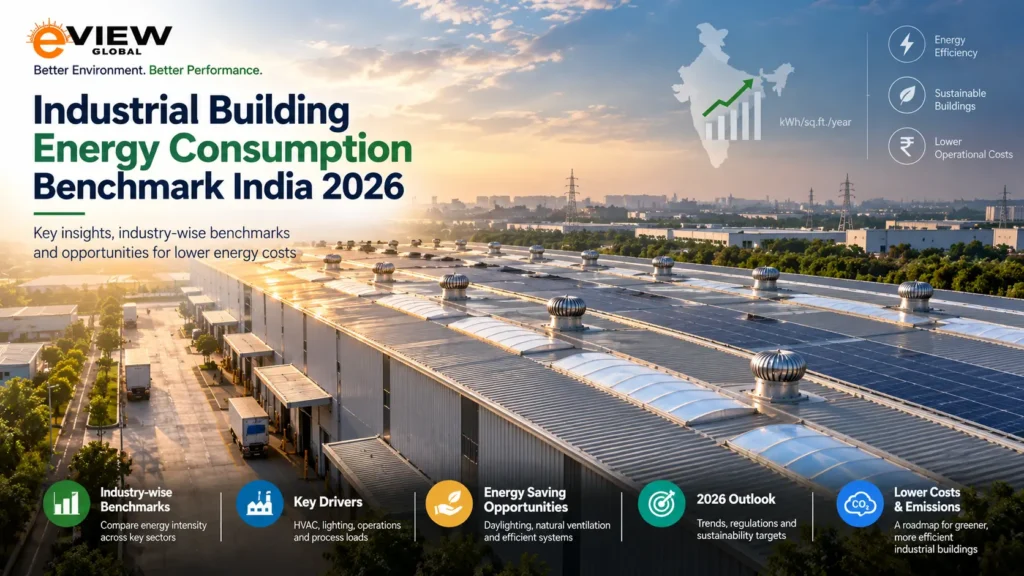
Industrial Building Energy Consumption Benchmark India 2026: Standards, EPI and Energy-Saving Opportunities
India’s industrial buildings are under increasing pressure to reduce electricity costs, improve operational efficiency and meet sustainability goals. For factories, warehouses and manufacturing facilities, understanding energy consumption is becoming an important step towards making buildings more efficient.
However, there is no single energy-consumption benchmark that applies to every industrial building in India. A warehouse, an assembly plant and a temperature-controlled manufacturing facility have very different energy requirements.
In this guide, we explore how to measure industrial building energy consumption in 2026, understand Energy Performance Index (EPI), compare facilities fairly and identify practical opportunities to reduce energy use.
1. What Is an Industrial Building Energy Consumption Benchmark?
An energy consumption benchmark is a reference used to assess how efficiently a building uses energy compared with similar buildings, established standards or its own historical performance.
For industrial buildings, benchmarking can help identify:
- Excessive electricity consumption.
- Inefficient lighting and cooling systems.
- High roof-related heat gain.
- Opportunities for natural daylighting and ventilation.
- Potential for rooftop solar energy.
- Improvements in building design and energy management.
The most useful benchmark compares buildings with similar functions, operating hours, production requirements, climates and occupancy levels.
2. How Is Industrial Building Energy Consumption Measured?
One widely used metric is the Energy Performance Index (EPI), measured in kilowatt-hours per square metre per year (kWh/m²/year).
The formula is:
For example, consider an industrial building with annual electricity consumption of 600,000 kWh and a floor area of 10,000 m².
Its EPI would be:
This figure becomes useful when compared with similar buildings using consistent measurement boundaries.
For factories, total electricity consumption may include production machinery, compressors, process heating, HVAC, lighting and other equipment. Where possible, separate building services from production-process energy. Otherwise, two factories with different manufacturing operations may appear inefficient or efficient for reasons unrelated to their buildings.
The Bureau of Energy Efficiency (BEE) uses EPI in its commercial-building star-rating programme and building energy-efficiency frameworks.
3. Is There a Standard Energy Benchmark for Industrial Buildings in India in 2026?
India has building energy-efficiency frameworks, but it is important to distinguish regulatory standards from actual energy-consumption benchmarks.
BEE’s Energy Conservation Building Code (ECBC) addresses building-envelope performance, HVAC systems, lighting, electrical systems and renewable energy. Its applicability depends on the building’s characteristics and the relevant state or local adoption requirements.
The Energy Conservation and Sustainable Building Code (ECSBC) 2024 is also listed among BEE’s building-sector resources.
For industrial facilities, a practical 2026 benchmarking framework should consider:
- Building energy: Lighting, ventilation, cooling and other building services.
- Process energy: Production machinery, furnaces, compressors and manufacturing equipment.
- Energy source: Electricity, natural gas, diesel and other fuels.
- Operating conditions: Shift patterns, production output and seasonal demand.
- Building design: Roof insulation, daylighting, ventilation and building orientation.
Separating these factors creates a more meaningful comparison than applying one national figure to every facility.
4. What Factors Increase Industrial Building Energy Consumption?
Several building and operational characteristics can increase energy use.
Roof heat gain: Poorly performing roofs can increase indoor temperatures and cooling demand, particularly in hot climates.
Artificial lighting: Facilities that rely entirely on electric lighting during daylight hours may miss opportunities to reduce lighting energy.
Inefficient ventilation: Poorly designed systems can waste fan energy or fail to remove heat effectively.
Equipment and maintenance: Inefficient motors, poorly maintained HVAC systems and compressed-air leaks can increase electricity consumption.
Operating schedules: Longer shifts and high production utilisation naturally increase energy demand, so comparisons should account for operating hours and output.
Understanding the dominant energy loads is the first step towards selecting the right improvement measures.
5. Industrial Energy-Saving Opportunities for 2026
Natural daylighting
Appropriately designed skylights and daylighting systems can reduce the need for artificial lighting during suitable daylight conditions. Glare, solar heat gain and light distribution should be considered during design.
Roof ventilation
Roof-level ventilation can help remove accumulated hot air when supported by suitable air inlets and building airflow design. The best solution depends on the climate, process heat and ventilation requirements.
Rooftop solar
On-site solar can offset a portion of a facility’s electricity demand. Evaluate roof suitability, structural capacity, daytime load, grid arrangements and project economics before installation.
Additional opportunities include high-efficiency lighting, occupancy controls, energy-efficient motors, variable-speed drives, improved insulation, sub-metering and regular energy audits.
The most effective combination depends on the facility’s measured energy profile rather than a standard package of upgrades.
6. How to Benchmark Your Industrial Building
Use this practical process to establish a reliable baseline:
- Collect 12 months of energy data: Gather electricity bills and available fuel-consumption records.
- Confirm the building area: Use a consistent floor-area definition for every reporting period.
- Calculate EPI: Divide annual energy consumption by the relevant floor area.
- Separate major loads: Measure lighting, HVAC, ventilation and production equipment where feasible.
- Normalise comparisons: Consider production volume, operating hours, climate and occupancy.
- Identify improvement opportunities: Prioritise measures based on expected energy savings, capital cost and operational impact.
- Track results: Review energy consumption and EPI regularly after improvements.
BEE’s building-efficiency resources and energy-performance frameworks provide useful reference points for this work.
7. The Outlook for Industrial Building Efficiency in India
Energy efficiency is increasingly relevant as India’s building stock expands and electricity demand grows. BEE highlights the importance of optimising energy demand in both new and existing buildings.
For 2026, the opportunity is to move beyond tracking electricity bills and towards data-led building performance management. Businesses can establish facility-specific baselines, identify high-consumption systems and evaluate upgrades using measured results.
For eView Global, this creates a relevant role for industrial daylighting, roof ventilation and building-envelope solutions as components of a wider energy-efficiency strategy. Their potential benefits should be assessed against each building’s design, climate, operational requirements and measured performance.
Conclusion
The most useful industrial building energy consumption benchmark in India for 2026 is one that reflects the building’s actual purpose and operating conditions.
EPI provides a straightforward starting point, while energy sub-metering and consistent reporting help reveal where improvements are possible. Building-envelope upgrades, natural daylighting, suitable roof ventilation, efficient equipment and rooftop solar can all contribute to a more energy-conscious facility.
Measure first, compare fairly and invest where the data shows the greatest opportunity.