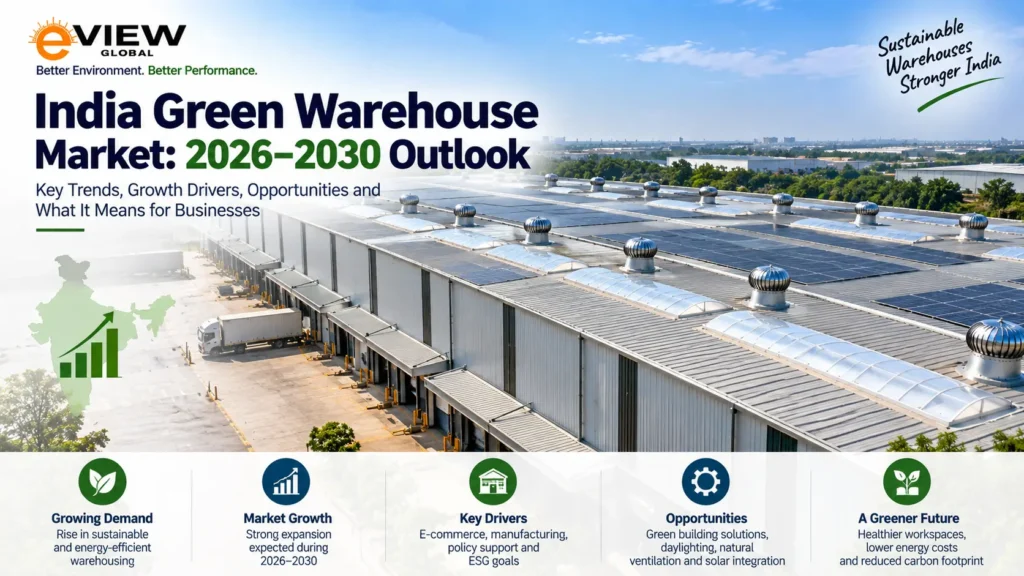
India’s warehousing industry is entering a new phase of growth. Rising e-commerce demand, manufacturing expansion, organized logistics and institutional investment are reshaping how warehouses are designed, developed and operated. Alongside this transformation, sustainability is becoming an increasingly important factor in industrial real estate.
From energy-efficient buildings and renewable energy to water conservation and green-certified infrastructure, developers and occupiers are rethinking what a modern warehouse should deliver.
The outlook for 2026-2030 is particularly significant. India’s green warehousing sector is expected to expand rapidly, creating opportunities for businesses that invest in sustainable industrial infrastructure today.
India’s Green Warehousing Market: Key Numbers and Growth Outlook
The scale of India’s green warehousing opportunity is reflected in recent industry research.
According to JLL’s 2025 report, India’s Sustainable Warehousing Landscape: A Greenprint.
- India’s certified green warehouse stock stood at approximately 65 million sq. ft. in 2024.
- Certified green warehouse space is projected to reach approximately 270 million sq. ft. by 2030.
- Total Indian warehousing stock is projected to reach approximately 885 million sq. ft. by 2030.
- Institutional-grade warehousing stock reached around 90 million sq. ft. in 2024, with approximately 72% green-certified or undergoing certification.
These figures indicate that sustainability is moving from a differentiating feature toward a more prominent consideration in the development of modern warehouses.
The growth outlook is also supported by the broader expansion of India’s logistics sector. CBRE’s 2026 market outlook highlights demand from third-party logistics providers, engineering and manufacturing businesses, and e-commerce occupiers. The sector is also seeing greater interest in high-quality assets and technology-enabled infrastructure.
What Is Driving Green Warehouse Growth in India?
1. E-commerce and modern supply chains
E-commerce and quick-commerce businesses require warehouses that support faster order processing, reliable inventory management and efficient distribution.
As logistics networks expand, occupiers increasingly need facilities that can handle operational demands while controlling energy and resource consumption. Modern warehouses are therefore being evaluated on more than location and storage capacity alone.
2. Manufacturing and industrial expansion
India’s manufacturing ecosystem is creating demand for organized industrial and logistics infrastructure. Warehouses supporting engineering, automotive, electronics, pharmaceuticals and other sectors need to accommodate different operational requirements.
Modern industrial facilities can integrate energy-efficient lighting, ventilation, renewable energy and sustainable building materials into their design. These features can support operational efficiency while helping businesses work toward sustainability objectives.
3. Institutional investment and green certification
Institutional investors and large corporate occupiers are influencing the standards expected from modern warehousing assets.
Green building certifications such as LEED, IGBC and GRIHA provide frameworks for evaluating areas such as energy performance, water efficiency, materials and environmental impact.
JLL’s research indicates that institutional participation is an important driver of India’s green warehousing transition. As developers compete for large corporate tenants and investment, sustainability is becoming a more significant part of asset planning.
4. Corporate sustainability commitments
Many companies have established environmental targets covering energy consumption, emissions and resource efficiency. Their sustainability priorities can influence the facilities they lease, operate and build.
For warehouse developers, this creates an opportunity to design facilities that align with occupier expectations. Energy efficiency, renewable electricity, water management and waste reduction can all contribute to a more comprehensive sustainability strategy.
The Role of Energy-Efficient Roofing in Green Warehouses
A warehouse roof is more than a protective structure. It can contribute directly to building performance.
Large industrial roofs offer opportunities to introduce natural daylight, support rooftop solar installations and improve ventilation where appropriate. However, these systems must be planned around structural capacity, thermal performance, roof design and operational requirements.
Natural daylighting to reduce lighting demand
Large warehouses often have deep internal spaces where daylight from conventional windows may be limited. Industrial daylighting systems, including suitable skylights, tubular daylighting systems and daylighting roof panels, can bring natural illumination into these areas.
When properly designed, daylighting can reduce dependence on artificial lighting during suitable daylight hours. The actual benefit depends on building geometry, operating schedules, daylight availability, lighting controls and the activities performed inside the facility.
Rooftop solar for renewable electricity
Industrial rooftops can also provide suitable areas for solar photovoltaic systems. Rooftop solar generates electricity on-site and can help reduce grid electricity purchases, depending on generation capacity and the facility’s energy-use pattern.
Solar feasibility depends on roof condition, orientation, shading, structural capacity, maintenance access and local solar conditions. A well-planned installation should consider these factors before determining system capacity.
Combining daylighting and rooftop solar
The strongest opportunity may come from coordinating both technologies rather than treating them as separate investments.
Daylighting can reduce a portion of the electricity required for indoor illumination. Rooftop solar can then generate electricity for the facility’s remaining needs. Integrated planning also helps allocate available roof space between daylighting systems, solar panels, ventilation equipment and maintenance access.
For developers planning new green warehouses, this approach can support a more complete energy-efficiency strategy.
Green Warehouse Trends to Watch Between 2026 and 2030
Several developments are likely to influence the next phase of India’s sustainable warehousing market.
- Green-certified Grade A warehouses: Demand for high-quality facilities is encouraging developers to consider sustainability from the early design stage.
- Solar-ready industrial roofs: New warehouses can be planned with suitable structural provisions, access routes and electrical infrastructure for rooftop solar.
- Retrofitting existing warehouses: Older facilities may offer opportunities to improve lighting, roofing, ventilation and energy performance without replacing the entire building.
- Smart energy management: Monitoring systems, efficient equipment and building controls can help operators understand consumption patterns and identify opportunities to reduce waste.
- More integrated industrial infrastructure: Future-ready warehouses will increasingly need to coordinate energy, lighting, ventilation, water management, safety and logistics requirements.
The pace of adoption will vary across cities, asset types and occupiers. Project economics, financing, land availability and technical feasibility will continue to influence investment decisions.
What This Market Outlook Means for Warehouse Developers
For warehouse developers and industrial property owners, the 2026-2030 outlook presents an opportunity to plan for long-term performance rather than focusing only on initial construction costs.
A sustainable warehouse strategy should consider:
- Energy demand and opportunities for efficiency
- Natural daylighting requirements
- Rooftop solar feasibility
- Roof structure and material selection
- Ventilation and thermal comfort
- Water conservation and rainwater management
- Green certification objectives
- Maintenance, operating costs and lifecycle value
Considering these elements together can help reduce design conflicts and support better-informed investment decisions.
A green warehouse is not defined by a single technology. Its performance depends on how the building’s systems work together throughout its operating life.
How eView Global Supports the Shift Toward Sustainable Warehousing
As India’s warehousing sector moves toward more sustainable infrastructure, industrial roofing and daylighting solutions have an important role to play.
eView Global focuses on solutions that help industrial buildings make better use of natural daylight and roof space. Products and systems such as skylights, daylighting solutions, roof ventilation products and other industrial roof applications like RRPA roofing can contribute to the performance requirements of modern facilities when selected and designed appropriately.
For warehouse developers, integrating daylighting into the roof strategy can help address indoor illumination requirements while coordinating with other building systems. Where rooftop solar is planned, early coordination can help ensure that daylighting openings, solar panel layouts, maintenance access and structural requirements are considered together.
The objective is to support practical, site-specific solutions that align with each facility’s operational and sustainability goals.
Conclusion: India’s Green Warehouse Opportunity Through 2030
India’s green warehousing market is positioned for significant expansion between 2026 and 2030. JLL’s projection of approximately 270 million sq. ft. of certified green warehouse space by 2030 highlights the scale of the opportunity.
Growth in logistics, manufacturing, institutional investment and corporate sustainability commitments is expected to influence how warehouses are planned and operated.
For developers and occupiers, the next step is to look beyond storage capacity and consider the full performance of the building. Energy-efficient roofing, natural daylighting, rooftop solar and responsible resource management can all contribute to a more sustainable warehouse.
As the market evolves, facilities that combine operational efficiency with thoughtful sustainability planning may be better positioned to meet the expectations of modern supply chains.
The future of warehousing in India is not just about building more space. It is about building smarter, more efficient and more sustainable spaces.
SEO Publishing Package
SEO title:
India Green Warehouse Market 2026-2030 Outlook | eView Global
Suggested URL slug:
india-green-warehouse-market-outlook-2026-2030
Focus keyphrase:
India green warehouse market
Supporting keywords:
Green warehousing India, sustainable warehouses, green warehouse market 2030, energy-efficient warehouse, industrial daylighting, rooftop solar for warehouses
Meta description:
Explore India’s green warehouse market outlook for 2026-2030, including growth drivers, market data, sustainability trends and energy-efficient roofing.
Featured image alt text:
Modern green warehouse with natural daylighting and rooftop solar panels in India
Internal linking:
Link to relevant eView Global daylighting products (Brilantor, SkyPipe), roof ventilation solutions (Turbo Ventilators), industrial applications, projects and contact page.
SEO note:
Use the focus keyphrase naturally in the introduction, one heading, SEO title and meta description. Add relevant internal links and a descriptive featured-image alt text.
Research Sources
- JLL: Green warehousing footprint in India to quadruple by 2030 – https://www.jll.com/en-in/newsroom/green-warehousing-footprint-in-india-to-quadruple
- CBRE: India Logistics Market Outlook 2026 – https://www.cbre.co.in/insights/reports/india-logistics-market-outlook-2026
- Colliers: India’s Emerging Industrial & Warehousing Corridors – https://www.colliers.com/en-in/research