ESG and Industrial Buildings | Passive Daylighting & Ventilation | eView Global
The acronym ESG has moved from investor presentations into factory floors faster than most Indian industrial operators anticipated. Three years ago, ESG was a framework discussed in boardrooms of listed companies and in sustainability reports produced for international shareholders. Today, it is a procurement requirement, a supply chain audit criterion, a financing condition, and — for an increasing number of Indian manufacturers — a daily operational reality that shapes decisions about everything from raw material sourcing to the design of factory roofs.
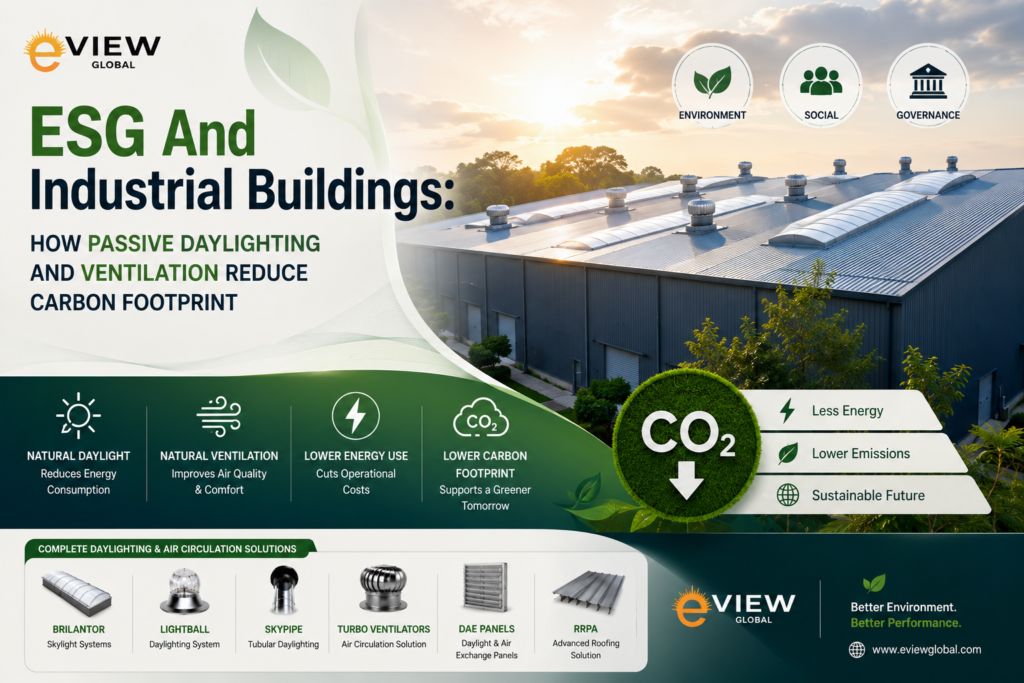
Passive daylighting and natural ventilation sit at a surprisingly central position in the ESG story for industrial buildings. Not because they are the most dramatic intervention a manufacturer can make, but because they are among the most direct, most measurable, and most immediately deliverable carbon reduction strategies available to any industrial facility — regardless of sector, scale, or location.
This blog explains the connection between passive building systems and ESG performance in detail — the carbon arithmetic, the reporting frameworks, the financing implications, and the practical reality of what daylighting and ventilation actually contribute to an industrial building’s ESG profile.
What ESG Actually Demands from Industrial Buildings
ESG — Environmental, Social, and Governance — is not a single standard. It is a family of overlapping frameworks, each placing slightly different demands on the companies it evaluates. However, across BRSR, GRI, CDP, TCFD, and SEBI’s mandatory sustainability disclosure requirements, industrial buildings face a consistent set of expectations on the environmental dimension:
- Scope 2 emissions reduction. Scope 2 covers the indirect greenhouse gas emissions associated with purchased electricity. For most industrial facilities, electricity consumption is the dominant source of Scope 2 emissions. Every unit of electricity eliminated through passive building systems — natural daylighting replacing artificial lighting, passive ventilation replacing mechanical cooling — directly reduces Scope 2 emissions. Moreover, the reduction is verifiable, calculable using published grid emission factors, and auditable by third-party assessors.
- Energy intensity improvement. Beyond absolute emissions, ESG frameworks increasingly focus on energy intensity — the energy consumed per unit of production output. Reducing a facility’s electricity consumption through passive systems improves the energy intensity ratio directly, contributing to BEE PAT scheme compliance and strengthening the SEC (Specific Energy Consumption) metrics that Indian manufacturers report against sector benchmarks.
- Physical climate risk management. Frameworks including TCFD now require companies to disclose how they are managing physical climate risks — including the impact of rising temperatures on operations, workforce productivity, and facility performance. A factory that has invested in passive cooling through natural ventilation is demonstrably better positioned against heat-related operational risk than one that has not. This is increasingly recognised by ESG assessors as a governance and resilience measure, not merely a comfort improvement.
- Workforce environmental health. The Social dimension of ESG includes worker health, safety, and environmental conditions. Thermal stress in poorly ventilated industrial facilities is a documented occupational health risk. Natural ventilation that reduces internal temperatures by 5°C to 10°C and achieves 10 to 20 air changes per hour directly improves the environmental health conditions of the workforce — a measurable contribution to the S in ESG.
The Carbon Arithmetic: Passive Systems and Scope 2 Reduction
Let us move from framework to numbers — because the carbon reduction from passive daylighting and ventilation is more substantial than most facility managers intuitively expect.
India’s electricity grid carries a carbon emission factor of approximately 0.71 kg of CO₂ equivalent per kWh, according to Central Electricity Authority data. Every kilowatt-hour of electricity eliminated from a facility’s consumption reduces its Scope 2 emissions by 0.71 kg CO₂e. At scale, this adds up quickly.
Natural Daylighting: The Lighting Electricity Calculation
Consider a 75,000 square foot manufacturing facility running 150 high-bay LED fittings at an average of 175W each. The lighting load is 26.25 kW. Operating for 10 hours a day across 300 working days per year, the annual lighting electricity consumption is 78,750 kWh.
A Brilantor natural daylighting installation covering 80% of the floor area eliminates artificial lighting in that zone during all daytime hours. The eliminated electricity consumption: approximately 63,000 kWh per year.
Carbon reduction from daylighting alone: 63,000 × 0.71 = 44,730 kg CO₂e — nearly 45 tonnes per year.
That is the carbon equivalent of taking approximately 19 to 20 petrol-powered passenger cars off the road for a year. From one facility. Through one passive system with no moving parts and zero operational energy consumption.
Passive Ventilation: The Cooling Electricity Calculation
The carbon saving from natural ventilation is harder to calculate universally because it depends on what mechanical cooling system it replaces or reduces — but it is equally real.
For a facility using evaporative cooling systems to manage internal temperatures, a turbo ventilator installation achieving 12 to 15 air changes per hour typically reduces mechanical cooling runtime by 60% to 80% during the moderate-temperature months that represent the majority of the working year. In a facility running 10 evaporative cooler units at 1.5 kW each across 8 hours a day, the baseline cooling electricity consumption is 36,000 kWh per year.
A 70% reduction in cooling runtime eliminates 25,200 kWh annually — a further 17,892 kg CO₂e, approximately 18 tonnes per year.
Combined with the daylighting saving, the total Scope 2 carbon reduction for this single 75,000 square foot facility approaches 63 tonnes of CO₂ equivalent per year — from two passive systems with a combined installation cost that pays back through electricity savings within three to four years.
Across a portfolio of five facilities, the aggregate annual carbon reduction exceeds 300 tonnes CO₂e — a figure that begins to be material in the context of corporate sustainability targets and CDP disclosure commitments.
ESG Reporting: Making Passive Systems Count
Carbon reductions from passive building systems are fully reportable under every major ESG framework — but only if they are documented correctly. This is where many industrial companies leave value on the table. They install daylighting or ventilation systems, benefit from the electricity savings, but fail to capture and report the associated carbon reductions in a way that strengthens their ESG disclosures.
The correct approach is straightforward:
- Establish a pre-installation baseline. Before installation, the facility’s lighting and cooling electricity consumption is measured and documented — ideally from electricity bills and submetering data covering a full 12-month period. This baseline is the reference point against which all subsequent savings and reductions are calculated.
- Calculate post-installation consumption. After the daylighting and ventilation systems are commissioned, electricity consumption in the affected categories is measured for a comparable 12-month period.
- Apply the grid emission factor. The reduction in kWh is multiplied by the applicable grid emission factor — currently 0.71 kg CO₂e per kWh for India — to calculate the Scope 2 emission reduction in tonnes of CO₂ equivalent.
- Document the methodology. Under GRI 305 (Emissions), BRSR, and CDP’s Climate Change questionnaire, the methodology for calculating emission reductions must be disclosed alongside the figures. A site assessment report and post-installation performance documentation from eView Global provides the technical foundation for this methodology disclosure.
This documented approach produces carbon reduction figures that are auditable, defensible under third-party verification, and directly usable in BRSR annual reports, CDP submissions, GRI disclosures, and sustainability communications to export customers and investors.
Green Financing: How ESG Performance Unlocks Better Capital
One of the less-discussed but commercially significant consequences of strong ESG performance in Indian industry is its impact on financing costs. The green finance market in India is growing rapidly — and passive building improvements are among the most directly eligible investments.
Green bonds and sustainability-linked loans issued by Indian banks and development finance institutions increasingly require borrowers to demonstrate measurable environmental performance improvements. RBI’s green finance guidelines and SEBI’s green bond framework both recognise energy efficiency improvements in industrial facilities as eligible green expenditures. A documented daylighting and ventilation upgrade — with verified electricity savings and Scope 2 emission reductions — qualifies as an eligible investment under these frameworks.
Export financing advantages. Indian manufacturers supplying to European buyers are increasingly encountering Carbon Border Adjustment Mechanism (CBAM) considerations and supply chain Scope 3 emissions scrutiny. Demonstrating a lower carbon footprint in manufacturing operations — supported by documented passive building improvements — strengthens the negotiating position with international buyers and reduces the risk of supply chain carbon surcharges as CBAM mechanisms mature.
ESG-linked working capital. Several major Indian banks now offer preferential working capital rates to companies that meet defined ESG performance thresholds. Energy intensity improvements and verified Scope 2 reductions are among the most commonly cited performance criteria. A daylighting and ventilation upgrade that generates documented improvements in both metrics directly contributes to meeting these thresholds.
GRIHA, LEED, and IGBC: How Passive Systems Drive Certification Scores
Green building certifications are the most tangible ESG credential an industrial building can hold — and passive daylighting and ventilation systems are among the highest-scoring interventions available within each framework.
- GRIHA (Green Rating for Integrated Habitat Assessment) — India’s national green building rating system — awards credits for reduction in artificial lighting load through daylighting provision, natural ventilation rates measured against occupant comfort criteria, and overall reduction in building energy consumption against the baseline. A well-designed eView Global daylighting and ventilation installation contributes to credits across multiple GRIHA criteria simultaneously.
- LEED for Industrial Facilities awards Indoor Environmental Quality credits for daylighting — specifically, the percentage of regularly occupied floor area achieving defined illuminance levels from natural sources — and Energy and Atmosphere credits for reduction in mechanical system energy consumption through passive design strategies. Both are directly addressed by eView Global’s integrated solution.
- IGBC Green Factory Building — the certification framework specifically designed for Indian manufacturing facilities — includes direct credits for daylighting coverage as a percentage of production floor area, natural ventilation provision measured in ACH, and overall energy performance improvement. eView Global’s project documentation — lux measurements, ACH calculations, pre- and post-installation energy consumption data — provides the precise evidence that IGBC assessors require.
For Indian manufacturers pursuing certification, the site assessment, technical design documentation, and post-installation performance reports that eView Global produces as standard project deliverables significantly accelerate the certification evidence-gathering process.
The ESG Case Is Also the Business Case
The single most important insight for Indian industrial operators approaching ESG through the lens of passive building systems is this: the ESG case and the business case are the same case.
Passive daylighting eliminates lighting electricity costs. That is a direct operational saving — rupees removed from the electricity bill every month. It also reduces Scope 2 carbon emissions. That is an ESG metric. The same intervention, the same outcome, measured through two different lenses.
Natural ventilation reduces internal temperatures and eliminates or reduces mechanical cooling costs. That is an operational saving. It also improves workforce thermal comfort, reduces heat-related absenteeism, and lowers the facility’s carbon footprint. Those are ESG metrics — Environmental and Social simultaneously.
There is no trade-off between the commercial case and the sustainability case for passive industrial building systems. They are the same investment, generating the same outcomes, measurable on the P&L and in the ESG report. The payback period of three to four years is the same whether you are calculating it as an energy cost reduction or as a carbon abatement investment. The 20-year service life generates the same cash flows whether you account for them as electricity savings or avoided carbon costs.
eView Global has delivered this combination — commercial return and ESG performance, from the same installation, verified and documented — across 1,540+ projects with clients including Bajaj, Tata Motors, Bosch, Mahindra, Aditya Birla, and Godrej. The track record is established. The methodology is proven. The documentation is in place.
Starting the ESG Journey on Your Roof
For most Indian industrial facilities, the fastest, most measurable, and most cost-effective first step in an ESG improvement programme is a passive building upgrade — natural daylighting and natural ventilation, engineered to the specific characteristics of the facility.
The starting point is a site assessment that establishes the pre-installation baseline: current electricity consumption, current Scope 2 emissions, current lux levels, current internal temperatures, and current ventilation performance. Everything that follows — the system design, the installation, the post-installation performance measurement, and the ESG documentation — builds from that baseline.
That assessment is where eView Global’s engagement begins. And for over 1,540 Indian industrial facilities, it is where a better, greener, more efficient building began too.