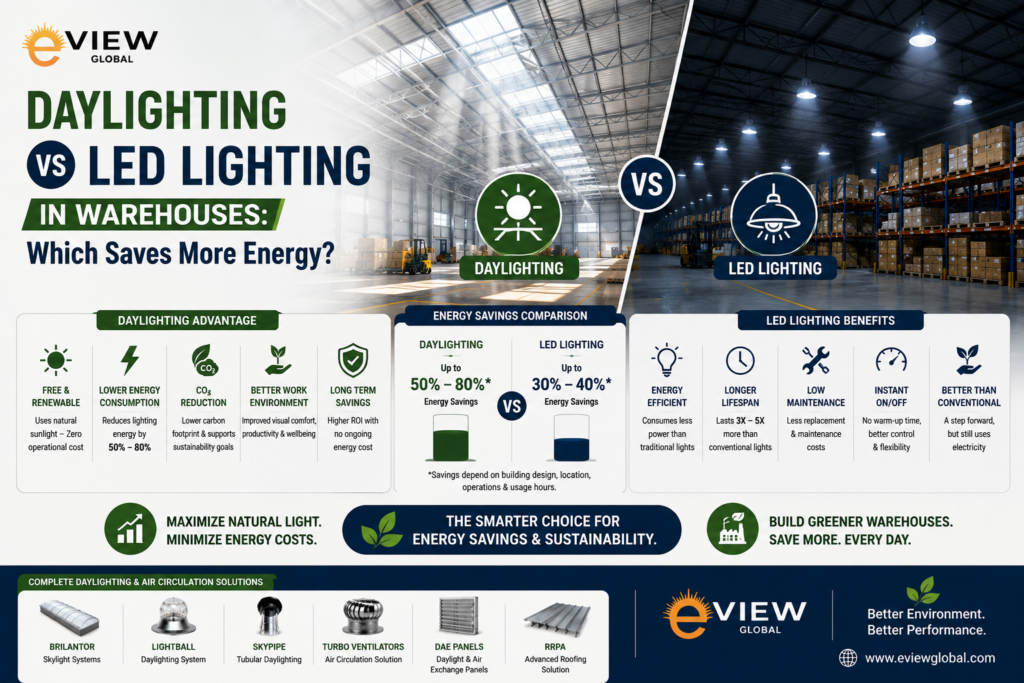
Natural daylighting vs LED warehouse | Warehouse energy savings India | Industrial daylighting solution | eView Global
Every warehouse manager upgrading their lighting faces the same fork in the road. LED fittings on one side well-understood, well-marketed, and sitting in a familiar capital expenditure category. Natural daylighting on the other less familiar, harder to budget intuitively, and still carrying misconceptions left over from an era of polycarbonate sheets and leaking skylights. The LED industry has done an excellent job of communicating its energy efficiency story. However, it is not the complete picture and for Indian warehouse operators making the best long-term energy decision, the incomplete picture is an expensive one.
The Setup: What We Are Actually Comparing
LED high-bay lighting electrical fittings consuming grid electricity, generating light and heat as byproducts, running from the start of the first shift to the end of the last, every operational day of the year.
Natural daylighting systems – passive building envelope components (Brilantor diffusion panels, LightBall dome diffusers, or SkyPipe tubular skylights) that capture and distribute free solar energy as usable interior light, consuming zero electricity and generating zero heat from the lighting system itself.
The meaningful comparison in 2025 and beyond is not LED versus older technology. It is LED versus passive daylighting: electricity cost versus zero electricity cost during daylight hours.
Round 1: Energy Consumption
A 1,00,000 square foot warehouse requiring 200 high-bay LED fittings at 160W each:
- LED-only annual consumption: 32 kW x 10 hours x 300 days = 96,000 kWh per year
- Daylighting-primary annual consumption (20% LED residual zone): ~19,200 kWh per year
- Energy saving from daylighting over LED: 76,800 kWh per year – an 80% reduction
No LED technology – regardless of efficiency rating, smart controls, or occupancy sensing can compete with a system that consumes zero electricity during daytime hours across 80% of the floor area. The physics do not permit it.
Round 2: Cost Savings Over Time
- LED-only annual lighting cost: 96,000 kWh x ₹8.50 = ₹8,16,000 per year
- Daylighting-primary annual lighting cost: 19,200 kWh x ₹8.50 = ₹1,63,200 per year
- Annual saving from daylighting: ₹6,52,800 over six and a half lakh rupees per year
- Payback period on daylighting installation (₹20-28 lakhs): 3 to 4 years
- 20-year cumulative saving at 6% annual tariff escalation: exceeds ₹1.5 crore
Natural daylighting panels have no electrical components to fail, no drivers to replace, and no depreciation curve in light output. A Brilantor panel installed today performs to specification in year 15 the same way it did in year one. LED fittings, by contrast, require driver replacements and fixture upgrades over the same period adding ₹4 to ₹8 lakhs to the total cost of ownership across 20 years.
Round 3: Heat Generation
This is the factor LED marketing almost never mentions and it matters significantly in the Indian warehouse context. Every LED fitting releases 50% to 60% of its electrical input as heat into the warehouse environment. For 200 fittings at 160W, that is 16 to 19 kW of continuous thermal load during operational hours compounding solar heat gain and making the working environment hotter and less productive.
Natural daylighting systems generate zero heat within the warehouse. Brilantor’s multi-layer diffusion technology specifically blocks infrared solar radiation while transmitting visible daylight. Switching off 160 fittings in the daylighted zone eliminates 12 to 15 kW of continuous heat generation. Combined with turbo ventilators and DAE Panels achieving 10 to 20 air changes per hour, the combined temperature reduction can reach 7°C to 12°C against a fully artificial, unventilated baseline.
Round 4: Carbon Footprint
- LED-only Scope 2 emissions: 96,000 kWh x 0.71 kg CO₂e = 68 tonnes CO₂e per year
- Daylighting-primary Scope 2 emissions: 19,200 kWh x 0.71 = ~14 tonnes CO₂e per year
- Annual carbon reduction: ~54 tonnes CO₂e equivalent to 23 petrol cars off the road per year
- 20-year cumulative carbon reduction: exceeds 1,000 tonnes CO₂e in a single warehouse
LED lighting is not a zero-carbon technology it consumes grid electricity at India’s current carbon intensity of 0.71 kg CO₂e per kWh. Natural daylighting is, by definition, a zero-carbon lighting technology during operational hours. For BRSR reporting, CDP disclosures, and supply chain sustainability audits from European and North American buyers, this distinction is increasingly material.
Round 5: Light Quality and Worker Wellbeing
Even the best LED fitting produces artificial light and the human body knows the difference. Research consistently finds natural light provides benefits artificial light cannot replicate:
- Circadian rhythm support – natural daylight’s full spectral range regulates the body’s internal clock, supporting alertness during working hours. LED light, even at high CRI values, does not replicate the dynamic spectral shift of natural daylight across the day.
- Reduced eye strain natural diffused daylight produces less visual fatigue than point-source fittings, particularly in inventory picking, quality inspection, and label reading.
- Psychological wellbeing exposure to natural light improves mood, reduces stress, and increases reported job satisfaction translating into lower absenteeism and better workforce retention.
The Verdict: Which Saves More Energy?
The answer is unambiguous. Natural daylighting saves significantly more energy than LED lighting during daytime operational hours by the full electricity consumption of the LED system across the daylighted zone. Zero versus non-zero is not a close comparison.
However, the most useful framing for most Indian warehouse operators is not LED versus daylighting as competing choices it is LED plus daylighting as a sequenced strategy. LEDs remain as backup and evening lighting. The daylighting system eliminates their daytime electricity consumption. The combination delivers zero electricity cost for lighting during all daylight hours, with reliable artificial lighting available whenever needed.
This is the approach eView Global implements across its 1,540+ industrial daylighting installations designing Brilantor, LightBall, and SkyPipe systems to complement and deactivate the existing artificial lighting infrastructure during daylight hours, rather than replace it entirely.