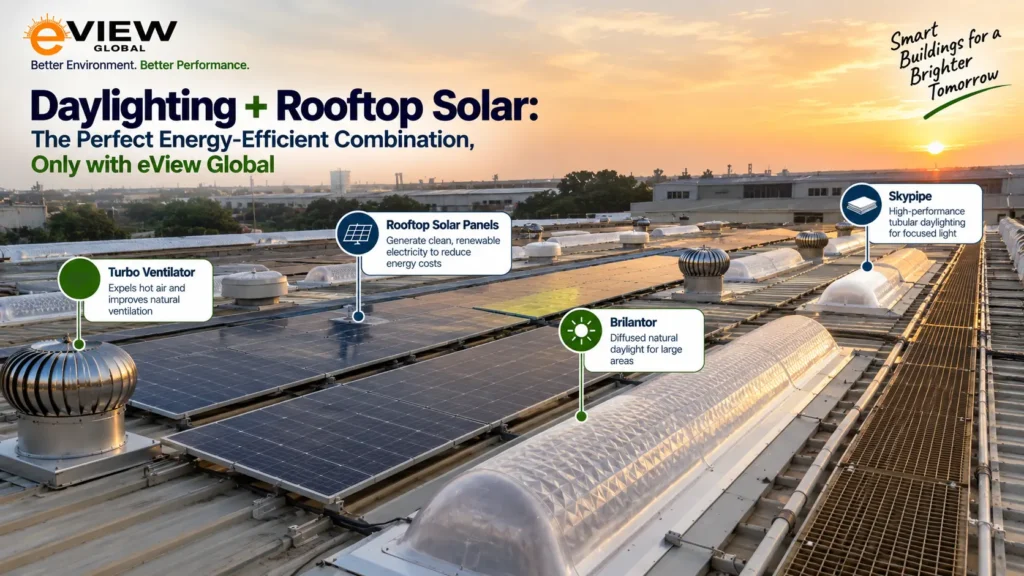
Factories and warehouses have a valuable resource above them: large roof areas exposed to sunlight. With thoughtful planning, these spaces can do more than protect operations. They can help bring natural light indoors, generate renewable electricity and support lower long-term energy costs.
That is why combining industrial daylighting and rooftop solar power is a practical approach to energy-efficient building design. Daylighting can reduce the electricity needed for artificial illumination, while solar panels generate power for the facility’s remaining electrical needs.
At eView Global, the focus is on bringing these complementary solutions together through coordinated industrial roof planning. The aim is to make daylighting and solar work as parts of one energy strategy-not as two unrelated installations.
Why Combine Daylighting and Rooftop Solar?
Industrial facilities use electricity for lighting, machinery, ventilation and production. In large factories and warehouses, artificial lighting can represent a meaningful share of daytime electricity use, particularly where windows provide limited natural illumination.
Rooftop solar panels convert sunlight into electricity, but solar generation alone does not reduce the amount of energy a building needs for lighting. A daylighting system addresses that demand directly by introducing useful natural light into indoor work areas.
Put simply: daylighting helps reduce electricity demand, while rooftop solar helps supply the electricity that remains. Planning both together allows a facility to consider energy efficiency, renewable generation and available roof space at the same time.
How an Integrated Daylighting and Solar System Works
- Bring natural light into the building. Industrial daylighting solutions-including suitable skylights, tubular daylighting systems and daylighting roof panels-can distribute daylight into spaces that might otherwise rely on electric lights. Design and positioning should account for the work being performed, daylight availability, glare and heat gain.
- Generate electricity with rooftop solar. Solar panels are installed on appropriate roof sections and convert sunlight into electrical energy. The amount of useful generation depends on factors such as system capacity, orientation, shading, local solar conditions and the facility’s operating pattern.
- Coordinate the roof layout. A combined plan identifies where daylighting is required and which remaining areas are suitable for solar panels. Structural capacity, maintenance access, ventilation equipment, drainage and future roof needs should be considered before finalizing the layout.
Reduce Demand Before Sizing Solar
An effective energy plan begins by understanding how much electricity the facility uses-and where it is used. Reducing avoidable consumption can change the amount of solar capacity needed to meet a defined energy objective.
For illustration, imagine a factory that uses 100 units of electricity during daytime operations for lighting and other activities. If a daylighting design reduces lighting-related use by 25 units, the facility’s total daytime demand falls by that amount, assuming other consumption remains unchanged. Solar requirements can then be assessed against the updated demand and the facility’s wider energy profile.
This is an illustrative example, not a guaranteed saving. Actual results depend on the lighting load, daylight conditions, controls, operating hours, electricity tariffs and solar generation. The guiding principle is to improve energy efficiency first, then size renewable generation around the real requirement.
Make Better Use of Available Factory Roof Space
Industrial roofs have finite usable area. Solar modules, daylighting openings, ventilation equipment, walkways and structural constraints all compete for space. Maximizing panel count is not necessarily the same as maximizing the overall value of the roof.
Likewise, daylighting should be designed for useful illumination rather than simply adding as many openings as possible. Excessive glare, unwanted heat gain, water ingress risks and uneven light distribution can affect building performance.
A coordinated roof assessment should consider:
- Usable roof area, orientation and slope
- Solar panel placement, shading and access
- Indoor daylight requirements and distribution
- Structural load capacity and roof condition
- Ventilation, drainage and rainwater management
- Maintenance clearances and future expansion
Potential Energy and Financial Benefits
An integrated approach can influence operating costs and project returns in several ways:
- Lower lighting-related electricity use: When sufficient daylight is available, well-designed systems can reduce reliance on artificial lighting.
- More informed solar sizing: Understanding the reduced lighting demand gives planners a clearer picture of the facility’s remaining electricity needs.
- Coordinated roof utilization: Planning both technologies together can help allocate roof areas according to their most suitable use.
- Reduced grid electricity purchases: Daylighting savings and solar generation may reduce electricity drawn from the grid, depending on tariffs, generation and when energy is consumed.
- Support for long-term sustainability goals: Combining energy efficiency with renewable generation can form part of a broader industrial energy strategy.
These benefits do not guarantee a higher return on investment in every project. A feasibility study should compare capital costs, expected energy savings, solar output, maintenance, equipment life and the anticipated payback period.
Why Daylighting Matters in a Solar-Ready Factory
Renewable generation is only one part of an efficient energy strategy. Avoiding unnecessary electricity use is equally important. Industrial daylighting can help by delivering natural illumination to large internal spaces during suitable daylight hours.
The objective is controlled, useful light-not simply more sunlight. Design should consider the tasks performed in each area, illumination levels, glare, heat gain and how daylight varies throughout the day and across seasons.
When daylighting is planned alongside rooftop solar, the result is a more complete approach: reduce a portion of the building’s lighting demand and use the roof to generate electricity for other needs.
eView Global: Daylighting and Rooftop Solar Planned Together
eView Global focuses on helping industrial buildings make purposeful use of their roof areas through natural daylighting solutions and coordinated rooftop planning.
By considering daylighting requirements alongside suitable areas for solar installation, eView Global promotes an integrated approach to industrial roof optimization. Rather than treating the technologies as competing uses of roof space, the planning process considers how they can work together.
For factories and warehouses, this means assessing natural illumination, available roof area, structural and operational requirements, electricity demand and long-term objectives as parts of one plan. The intended outcome is a roof strategy that supports both indoor lighting needs and renewable electricity generation.
Positioning eView Global as the only company offering this exact combination is a strong exclusivity claim. It should be published only when the business can substantiate it with reliable, current evidence. The headline supplied for this article uses that positioning; the body describes the integrated approach without making unsupported market-wide comparisons.
Is the Combination Suitable for Every Factory?
Daylighting and rooftop solar can be relevant to many industrial buildings, but the right design is site-specific.
Before implementation, assess:
- Electricity consumption and daytime load profile
- Lighting requirements and existing lighting controls
- Roof condition, structural suitability and usable area
- Local sunlight, shading and solar generation potential
- Required daylight levels, glare and internal heat loads
- Installation, operation and maintenance costs
- Working shifts, production schedules and future changes
The Future of Industrial Roofing Is Integrated
Industrial roofs are increasingly being considered as active parts of building performance-not just weather-protection structures. Depending on the site, a modern roof may need to support natural illumination, ventilation, renewable generation, safe access and efficient water management.
Planning these functions together can help avoid conflicts between separate installations and make better use of available space. Combining daylighting with rooftop solar is one way for factories to reduce avoidable electricity use while generating power on-site.
Conclusion
The value of daylighting and rooftop solar lies in how the two technologies complement each other. Natural daylight can reduce the electricity required for artificial illumination, while rooftop solar can generate electricity for the facility’s remaining needs.
With careful design, this combination can support lower operating expenses, more considered roof utilization and better-informed energy investments. Results will vary by facility, so a site-specific technical and financial assessment is essential.
eView Global brings daylighting solutions and coordinated rooftop planning into the same conversation for factories and warehouses pursuing more energy-efficient industrial buildings.
Make your factory roof work smarter: bring natural daylight inside and generate clean electricity above.
SEO Publishing Details
SEO title:
Daylighting + Rooftop Solar | eView Global
Suggested URL slug:
daylighting-rooftop-solar-energy-efficient-combination
Focus keyphrase:
daylighting and rooftop solar
Supporting keywords:
industrial daylighting, rooftop solar for factories, factory energy efficiency, industrial solar solutions, daylighting systems for warehouses
Meta description:
Discover how eView Global combines industrial daylighting and rooftop solar to support factory energy efficiency, smarter roof use and lower electricity demand.
Suggested image alt text:
Industrial factory roof integrating natural daylighting systems and rooftop solar panels
Suggested internal links:
Link to relevant eView Global daylighting products (Brilantor, LightBall, SkyPipe), industrial applications, project pages and contact page where available.
SEO note:
Use the focus keyphrase naturally in the introduction, a relevant subheading, SEO title and meta description. Add descriptive image alt text and relevant internal links. Verify the exclusivity claim before publication.