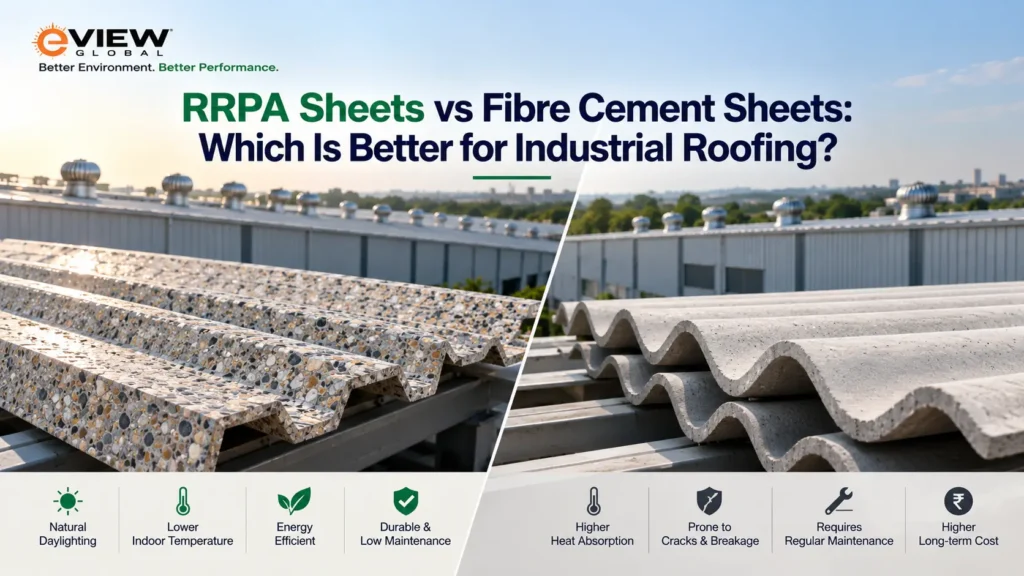
RRPA Sheets vs Fibre Cement Sheets: Which Is Better for Industrial Roofing?
Choosing the right roofing sheet is an important decision for factories, warehouses and industrial sheds. The material affects roof weight, maintenance, weather resistance, safety, long-term costs and building performance.
Two options buyers may compare are RRPA composite roofing sheets and fibre cement sheets. Both have uses, but they are made differently and have different performance considerations.
So, which is better for industrial roofing: RRPA or fibre cement? The answer depends on the building design, operating environment, fire and structural requirements, budget and the manufacturer’s tested specifications.
1. What Are RRPA Roofing Sheets?
RRPA is used by eView Global to describe Reinforced Regenerated Polyethylene Aluminium, a composite building material made using regenerated plastic with aluminium reinforcement or layers. It is positioned for industrial roofing, cladding, warehouses, factories and other building applications.
According to eView Global’s published product information, RRPA is designed to be lightweight, corrosion-resistant and resistant to moisture and termites, with recycled material used in its composition. Exact performance depends on product construction, thickness, fixing method and tested specifications.
Product information: https://eviewglobal.com/rrpa/
2. What Are Fibre Cement Roofing Sheets?
Fibre cement sheets are made from cement reinforced with fibres. Modern non-asbestos products may use cellulose or other reinforcing fibres and are commonly used for sheds, warehouses and industrial buildings.
Fibre cement is generally opaque, non-combustible and resistant to corrosion. However, it can be heavy and brittle, and must be supported and installed according to the manufacturer’s instructions. Roof access requires particular care because sheets can crack under concentrated loads.
Important: Specify non-asbestos fibre cement for new projects. Older asbestos-containing roofing requires specialist assessment and safe handling; it should not be cut, broken or removed casually.
3. RRPA vs Fibre Cement Sheets: Key Differences
| Comparison factor | RRPA sheets | Fibre cement sheets |
|---|---|---|
| Material | Composite with regenerated plastic and aluminium reinforcement/layers | Cement reinforced with fibres |
| Weight | Product-specific; marketed as lightweight | Often heavier; confirm sheet weight |
| Corrosion | Designed to resist rust and corrosion | Does not rust like steel |
| Moisture | Check product water-resistance details | Durable when correctly installed; detailing matters |
| Impact and handling | Depends on construction and support spacing | Brittle; can crack from impact or concentrated loads |
| Fire performance | Confirm exact product test reports and rating | Cementbased -sheet is generally non-combustible; confirm classification |
| Maintenance | Marketed as low-maintenance; inspect fixings and joints | Inspect for cracks, fasteners, laps and weathering |
| Sustainability | May incorporate regenerated/recycled plastic; verify documentation | Cement and fibre composition; impact varies by product |
| Best-fit considerations | Corrosion resistance and a lightweight composite option | Opaque, cement-based, non-combustible roofing where appropriate |
This comparison is a starting point, not a substitute for product data sheets, fire-test reports, structural calculations or project-specific advice.
4. Which Roofing Sheet Is Better for Industrial Buildings?
Choose RRPA when corrosion resistance is a priority
Industrial roofs may be exposed to humidity, coastal air, chemical atmospheres or moisture from the process environment. A composite sheet designed to resist corrosion may be worth evaluating where rust-related maintenance is a concern.
Before specifying RRPA, confirm tested strength, maximum support spacing, fixing details, UV and weathering performance, fire classification and suitability for the building’s loads. Do not assume all composite sheets perform identically.
Consider fibre cement when an opaque, cement-based roof is required
Fibre cement may suit projects where an opaque roof, non-combustible material and established construction methods are important. It does not corrode like unprotected steel, but its weight and brittle nature must be considered during structural design, installation and maintenance planning.
For either option, check local building requirements and the exact product’s certifications before finalising the specification.
5. Which Is More Cost-Effective: RRPA or Fibre Cement?
The lowest purchase price does not always mean the lowest lifetime cost.
Compare the complete installed roofing system, including:
- Sheet price and quantity.
- Structural support requirements.
- Fasteners, washers, flashings and sealing.
- Installation labour and access equipment.
- Expected inspection and maintenance costs.
- Repairs, replacement and production disruption.
- End-of-life handling and disposal.
RRPA may be attractive where corrosion resistance and reduced maintenance are valuable, while fibre cement may be competitive where its initial cost and project requirements align. A reliable cost comparison needs current quotations, local labour rates and product-specific service-life evidence. Avoid choosing solely on a general lifespan claim.
6. What About Heat, Daylighting and Ventilation?
Roofing material is only one part of industrial building performance. Indoor heat and lighting also depend on insulation, roof colour, building orientation, internal equipment, climate, ventilation and daylighting systems.
Fibre cement sheets are opaque, so daylight normally needs to enter through dedicated windows or daylighting panels. RRPA roofing sheets should not automatically be treated as daylighting products either; check the exact product’s light-transmission properties if natural light is required.
For facilities aiming to reduce daytime artificial lighting, purpose-designed industrial daylighting systems can be evaluated alongside the roof specification. Ventilation may help remove accumulated hot air when suitable inlets and an effective airflow path are provided.
eView Global offers RRPA alongside industrial daylighting and roof ventilation solutions. Planning these elements together can help project teams consider roof durability, indoor comfort and energy use as a coordinated system.
7. Checklist Before Selecting an Industrial Roofing Sheet
Before purchasing, ask the supplier for:
- Product technical data sheet and exact material composition.
- Sheet weight, thickness, dimensions and recommended support spacing.
- Structural performance and permitted installation details.
- Fire classification and supporting test documentation.
- UV, weathering, water-resistance and chemical-resistance evidence where relevant.
- Fastener, flashing, joint and roof-penetration details.
- Warranty conditions, maintenance guidance and service-life assumptions.
- Compliance with applicable building codes and project specifications.
For existing roofs, also check purlins, corrosion, leaks, structural capacity and safe access. Replacement should be planned by qualified professionals, especially where old asbestos-containing sheets may be present.
Conclusion: RRPA or Fibre Cement-Which Should You Choose?
There is no single roofing sheet that is best for every industrial building. RRPA may be worth evaluating where a lightweight composite material and corrosion resistance are priorities. Fibre cement may suit projects requiring an opaque, cement-based sheet with non-combustible characteristics, provided its weight and brittleness are properly managed.
The right choice should be based on verified product specifications, structural requirements, fire safety, installation quality, local environmental conditions and total lifecycle cost.
For factories and warehouses planning a new roof or replacement, eView Global can help assess RRPA as part of a broader industrial roofing, daylighting and ventilation strategy.
Compare the complete roofing system-not just the sheet price-and confirm the technical specifications before you buy.