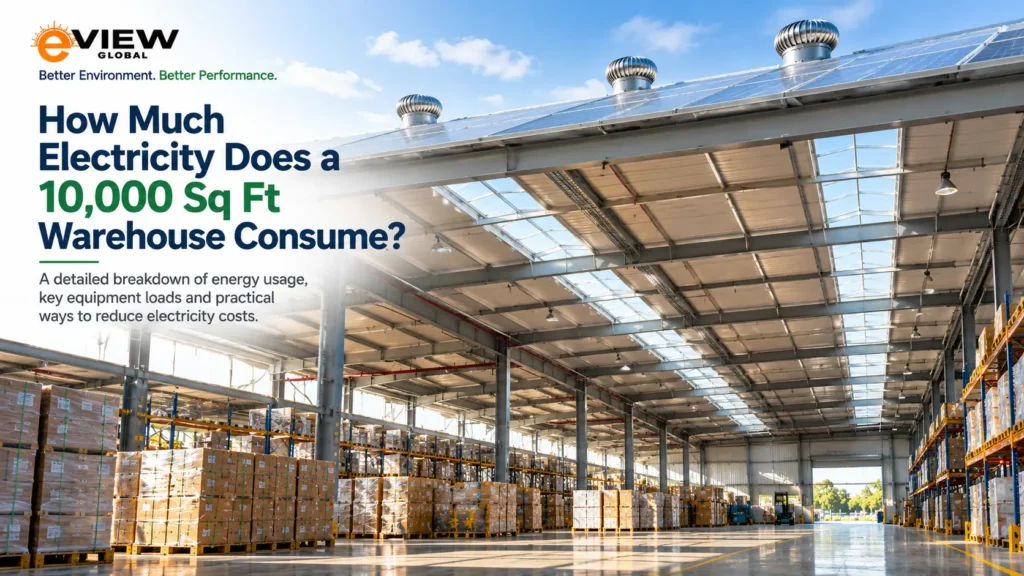
How Much Electricity Does a 10,000 Sq Ft Warehouse Consume? Cost, Calculation & Savings
A 10,000 sq ft warehouse may look like a simple storage building, but its electricity consumption can vary significantly depending on lighting, operating hours, ventilation, material-handling equipment and cooling requirements.
For warehouse owners and logistics companies in India, understanding electricity consumption is essential for controlling operating costs and improving energy efficiency.
So, how much electricity does a 10,000 sq ft warehouse consume?
The answer depends on how the warehouse operates. A basic storage facility can consume far less electricity than an automated distribution centre or a temperature-controlled warehouse.
This guide explains how to estimate warehouse electricity consumption, calculate monthly costs and identify opportunities to reduce energy use through efficient lighting, natural daylighting, roof ventilation and rooftop solar.
1. How Many Units of Electricity Does a 10,000 Sq Ft Warehouse Use?
Electricity consumption is measured in kilowatt-hours (kWh), commonly called units on electricity bills.
For an initial planning exercise, consider these illustrative scenarios, not official Indian industry benchmarks:
| Warehouse type | Example annual consumption |
|---|---|
| Basic storage, limited equipment | 20,000 kWh |
| Regular operations with lighting and fans | 35,000 kWh |
| Intensive operations with additional equipment | 60,000 kWh |
Actual consumption can fall outside these examples, especially for refrigerated facilities, highly automated warehouses or buildings with substantial air-conditioning.
International data also shows that warehouse energy use varies by building type and end use. The US Energy Information Administration, for example, reports different consumption patterns across warehouse and distribution-centre categories. These figures should not be treated as direct benchmarks for Indian facilities.
2. How Much Does It Cost to Run a 10,000 Sq Ft Warehouse?
Your electricity bill depends on the number of units consumed and your applicable tariff.
Use this formula:
For illustration, assume an electricity rate of ₹8 per unit. Your actual tariff may differ based on location, consumer category, demand charges, taxes and other billing components.
| Annual consumption | Average monthly units | Estimated monthly energy cost |
|---|---|---|
| 20,000 kWh | 1,667 | ₹13,336 |
| 35,000 kWh | 2,917 | ₹23,336 |
| 60,000 kWh | 5,000 | ₹40,000 |
These estimates cover energy charges only. The final bill may include fixed charges, demand charges, electricity duty and other applicable fees.
For a warehouse operating throughout the year, even a modest reduction in avoidable electricity use can translate into meaningful annual savings.
3. What Uses the Most Electricity in a Warehouse?
The main electricity-consuming systems depend on the building’s design and activities.
Warehouse lighting
High-bay lights illuminate storage racks, aisles, loading areas and workstations. In facilities operating during daylight hours, some lighting demand may be reduced through properly designed natural daylighting.
Ventilation fans
Fans help maintain air movement and may support heat removal. Their consumption depends on motor power, operating hours, airflow requirements and maintenance.
Material-handling equipment
Forklift charging stations, conveyors, automated storage systems and sorting equipment can add significantly to electricity demand.
Office and IT equipment
Computers, printers, networking equipment and office air-conditioning contribute to the building’s total consumption.
Cooling and refrigeration
Temperature-controlled warehouses can consume substantially more electricity than ordinary storage facilities because refrigeration and cooling operate to maintain specified conditions.
The first step towards savings is to identify which systems account for the largest share of your actual electricity bill.
4. How to Calculate Your Warehouse’s Electricity Consumption
You do not need to guess your electricity consumption. A simple equipment-based calculation can provide an initial estimate.
Formula:
Consider a hypothetical lighting system with 40 LED fittings, each rated at 150 watts.
Step 1: Calculate total lighting load
40 × 150 W = 6,000 W = 6 kW
Step 2: Calculate daily consumption
If the lights operate for 10 hours:
6 kW × 10 hours = 60 kWh per day
Step 3: Calculate annual consumption
Assuming 300 operating days:
60 × 300 = 18,000 kWh per year
This example covers lighting alone. Fans, equipment, office loads and cooling must be calculated separately to estimate total warehouse consumption.
For greater accuracy, use electricity bills and sub-meters to measure actual consumption.
5. Can Natural Daylighting Reduce Warehouse Electricity Bills?
Yes. When designed appropriately, natural daylighting can reduce the need for artificial lighting during suitable daytime conditions.
Industrial daylighting systems introduce natural light through carefully designed roof or building-envelope openings. This can be particularly useful in large warehouses with extensive roof areas and long operating hours.
Potential benefits include:
- Reduced reliance on artificial lighting during daylight.
- Lower electricity consumption associated with lighting.
- More balanced natural illumination when designed correctly.
- Opportunities to integrate daylighting into new buildings or planned roof upgrades.
However, results depend on roof design, daylight distribution, weather, operating schedules and whether lights are switched off or dimmed when sufficient daylight is available.
Daylighting should also be designed to manage glare, solar heat gain, weatherproofing and safety requirements.
6. Does Roof Ventilation Reduce Warehouse Electricity Consumption?
Roof ventilation can help remove accumulated hot air from high-level areas when the building has suitable air inlets and an effective airflow path.
This may improve indoor conditions in warehouses that experience significant heat build-up. However, roof ventilation does not automatically reduce electricity consumption in every building.
Its impact depends on the climate, internal heat sources, building layout and whether mechanical cooling is being used. Refrigerated warehouses require specialised design to avoid compromising temperature control.
For suitable facilities, evaluating natural ventilation alongside insulation, daylighting and efficient equipment can support a more complete energy-efficiency strategy.
7. Can Rooftop Solar Power Reduce Warehouse Electricity Costs?
A large warehouse roof may offer space for a rooftop solar installation, subject to structural suitability, shading, electrical arrangements and applicable approvals.
Solar generation can offset part of the electricity purchased from the grid, particularly when generation coincides with daytime consumption.
Before investing, evaluate:
- Available and structurally suitable roof area.
- Daytime electricity demand.
- Solar generation estimates for the location.
- Installation and maintenance costs.
- Grid connection and applicable net-metering or export rules.
- The relationship between solar generation and the warehouse’s operating schedule.
Natural daylighting, roof ventilation and rooftop solar serve different purposes. Daylighting can reduce lighting demand; ventilation can help manage heat; and solar panels generate electricity. A coordinated design can assess all three without assuming that one solution replaces the others.
8. Five Practical Ways to Reduce Warehouse Electricity Consumption
- Audit lighting: Check fitting wattage, operating hours, controls and opportunities to use daylight.
- Install sub-meters: Measure lighting, ventilation, office equipment and major machinery separately.
- Improve roof performance: Evaluate insulation and heat gain, particularly where indoor temperatures affect workers or equipment.
- Optimise operating schedules: Switch off or reduce lighting and equipment when areas are unoccupied, wherever operationally safe.
- Evaluate renewable energy: Compare rooftop solar options with the warehouse’s actual electricity demand and tariff.
The best investment is the one supported by measured consumption, realistic savings and a suitable payback period.
Conclusion: What Is the Real Electricity Cost of a 10,000 Sq Ft Warehouse?
A 10,000 sq ft warehouse does not have one fixed electricity requirement. Consumption depends on operating hours, lighting, equipment, cooling, refrigeration and the way the building is designed.
For an initial estimate, calculate the power consumption of major equipment, multiply it by operating hours and compare the result with actual electricity bills. Then identify the systems responsible for the largest avoidable loads.
For warehouse owners planning to improve building efficiency, eView Global’s industrial daylighting and roof-related solutions can be considered as part of a broader strategy that also evaluates ventilation, roof performance and rooftop solar.
The smartest first step is simple: measure where your electricity goes before deciding where to save it.