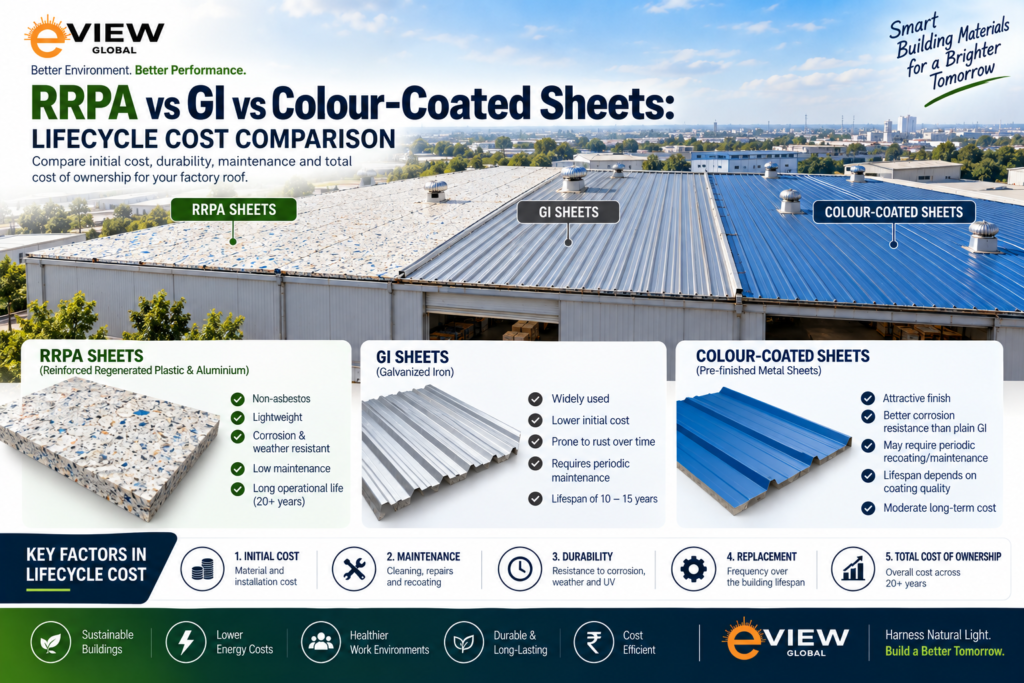
When choosing roofing for a factory, the cheapest sheet is not always the cheapest roof. This guide compares RRPA vs GI vs colour-coated sheets across the full lifecycle: maintenance, corrosion, repairs and downtime.
The initial price per square foot is only one part of the total cost. Over the years, maintenance, corrosion, repainting, leakage repairs, replacement and downtime can have a much bigger impact on the actual cost of a roof.
Three options commonly considered for industrial roofing are RRPA sheets, Gl sheets and colour-coated roofing sheets.
So, how do they compare over the complete lifecycle of a building?
Let’s look at the differences in a practical way.
What Is RRPA Roofing?
RRPA stands for Reinforced Regenerated Plastic & Aluminium.
It is a composite roofing material that combines regenerated/recycled plastic with aluminium reinforcement. eView Global describes RRPA as a non-asbestos alternative designed for industrial and modern construction applications.
Unlike conventional metal roofing, RRPA is not simply a steel sheet with a surface coating. Its composite construction is designed to provide properties such as corrosion resistance, waterproofing, low weight and reduced maintenance.
RRPA sheets are particularly relevant for:
- Factories
- Industrial sheds
- Warehouses
- Storage buildings
- Infrastructure projects
- Roofing and cladding applications
eView Global also positions RRPA as a rust-free, termite-resistant and weather-resistant building material with a virtually maintenance-free service profile.
What Are GI Roofing Sheets?
Gl stands for Galvanized Iron, commonly referring to galvanized steel sheets used for industrial roofing.
The steel is protected by a zinc coating, which helps resist corrosion. The quality and thickness of the zinc coating are important factors in determining the sheet’s durability.
In India, galvanized steel sheets are covered by IS 277:2018, which specifies requirements including mechanical properties, zinc coating and dimensions.
Gl sheets remain popular because they offer a relatively low initial cost and are widely available for industrial construction.
However, the roof’s environment matters.
Humidity, coastal salt, industrial pollution, scratches, cut edges and damaged areas can accelerate corrosion over time.
What Are Colour-Coated Roofing Sheets?
Colour-coated sheets are generally steel sheets with a metallic protective coating and an additional factory-applied paint system.
They are popular for factories, warehouses and commercial buildings because they combine structural strength with a finished appearance.
The additional coating can provide better surface protection than plain Gl, depending on the substrate, coating specification and environment.
However, colour-coated roofing is not completely maintenance-free. Scratches, coating damage, fasteners, moisture and harsh environmental conditions can eventually affect performance.
That means the initial purchase price should not be the only factor when comparing roofing materials.
RRPA vs GI vs Colour-Coated Sheets
| Factor | RRPA | GI Sheet | Colour-Coated Sheet |
|---|---|---|---|
| Basic material | Plastic + aluminium composite | Zinc-coated steel | Coated steel + paint |
| Rust risk | No conventional rusting | Possible over time | Lower, but coating damage matters |
| Maintenance | Very low | Periodic maintenance may be required | Low to moderate |
| Waterproofing | Designed for waterproof roofing applications | Depends on detailing and condition | Depends on detailing and coating |
| Weight | Lightweight | Moderate | Moderate |
| Appearance | Functional/composite finish | Metallic | Multiple colours |
| Corrosion resistance | High | Depends on environment/coating | Generally better than plain GI |
| Initial cost | Project dependent | Generally lower | Generally higher than basic GI |
| Lifecycle cost | Potentially low due to reduced maintenance | Can increase with repairs | Generally moderate |
| Best suited for | Long-term industrial applications | Budget-conscious industrial roofing | Industrial and commercial buildings |
The exact performance of any roofing system depends on material specification, thickness, installation quality, environment and maintenance.
Initial Cost vs Lifecycle Cost
This is where the comparison becomes interesting.
Suppose three roofing options have different purchase prices.
The Gl sheet may have the lowest initial cost.
A colour-coated sheet may cost more.
An RRPA system may have a higher upfront investment depending on the specification and project.
At first glance, Gl may appear to be the obvious economical choice.
But imagine that over the next 15-20 years the roof requires:
- Rust treatment
- Repainting
- Fastener replacement
- Leak repairs
- Sheet replacement
- Labour
- Periodic inspection
Those costs can change the overall calculation.
This is why industrial roofing should be evaluated using Total Cost of Ownership (TCO) rather than purchase price alone.
Lifecycle Cost: What Should You Include?
A proper roofing comparison should include five major costs.
1. Initial material cost
How much does the roofing material cost?
2. Installation cost
How much labour, structure modification and installation work is required?
3. Maintenance cost
How frequently will the roof need inspection, cleaning, coating or repair?
4. Repair and replacement cost
What happens when corrosion, leakage or physical damage occurs?
5. Operational downtime
This is often overlooked.
A roof repair in an operating factory can affect production, inventory, workers and schedules.
Even a relatively small repair can become expensive if it interrupts operations.
Why Corrosion Matters in Industrial Roofing
For metal roofing, the surrounding environment is extremely important.
A factory located in a humid, coastal or chemically aggressive environment may experience faster corrosion than a similar building in a dry inland location.
Gl roofing depends on its zinc coating for corrosion protection. Once the protective system is compromised, exposed steel can begin to deteriorate.
Colour-coated sheets add a protective paint layer, but scratches, cut edges and damaged coating still need attention.
RRPA, being a non-metallic composite roofing material with aluminium reinforcement, does not have the same conventional steel-rust mechanism.
This can be particularly relevant when the objective is to reduce long-term corrosion-related maintenance.
Which Roofing Sheet Requires Less Maintenance?
Maintenance depends on the product specification and installation quality, but the basic difference is clear.
GI: May require corrosion inspection, repairs and protective maintenance as the roof ages.
Colour-coated: Generally requires less surface maintenance than plain Gl, but the coating needs to be protected from damage and environmental exposure.
RRPA: Its composite construction is designed to avoid conventional rust-related maintenance, making low maintenance one of its key advantages.
For a large industrial building, reducing maintenance work can have value beyond the maintenance bill itself.
It can reduce the number of times workers need to access the roof and reduce interruptions to operations.
Is RRPA More Expensive Than GI?
The answer depends on the project.
Comparing only the price per sheet can be misleading.
A better comparison is:
Initial cost + installation + maintenance + repairs + replacement + downtime = lifecycle cost
Gl can be attractive when the primary objective is minimizing initial construction cost.
Colour-coated sheets can provide a balance between initial investment, appearance and corrosion protection.
RRPA can become more attractive when the project places greater importance on long-term durability, low maintenance and resistance to corrosion-related problems.
The correct decision therefore depends on the building’s expected service period and operating environment.
Which One Makes Sense for a Factory?
Choose GI when:
The project is highly budget-driven and the environment and expected service period are suitable for conventional galvanized roofing.
Consider colour-coated sheets when:
You want a finished appearance along with additional surface protection and are prepared to maintain the roofing system over its service life.
Consider RRPA when:
Long-term durability, corrosion resistance, low maintenance and a non-asbestos composite roofing solution are important priorities.
For large factories and warehouses, the decision should be based on the complete lifecycle, not just the quotation received from the supplier.
The Real Question Is Not “Which Sheet Is Cheapest?”
It is:
“Which roofing system will cost less to own over the next 15-20 years?”
A sheet that costs less today can become more expensive if it requires frequent repairs or replacement.
Likewise, paying more upfront does not automatically mean a better investment.
The right material should match:
- Building location
- Climate
- Industrial environment
- Roof design
- Expected service life
- Maintenance strategy
- Budget
- Operational requirements
Final Takeaway
RRPA, GI and colour-coated roofing sheets each have their place in industrial construction.
Gl remains a practical option where initial cost is a major consideration.
Colour-coated sheets provide an upgraded finish and additional surface protection compared with basic Gl.
RRPA takes a different approach by using a reinforced regenerated plastic and aluminium composite designed for durability, corrosion resistance and reduced maintenance.
For a factory or warehouse, the best roofing decision should therefore go beyond the initial quotation.
Look at the total cost of ownership.
A roof that requires fewer repairs, less maintenance and fewer replacements can deliver greater value over its complete lifecycle even if its initial purchase price is higher.
At eView Global, RRPA roofing solutions are designed for industrial buildings, factories, warehouses and other applications where long-term performance and reduced maintenance matter.
Before choosing a roofing sheet, compare not only what you pay today-but what the roof is likely to cost you over its entire working life.