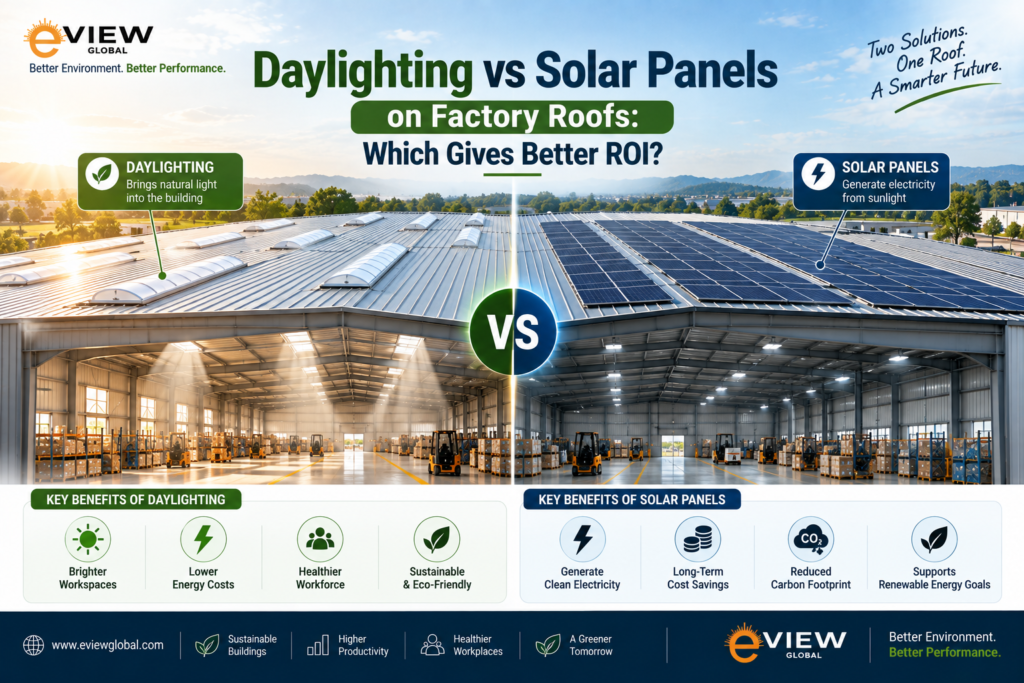
Factory owners are increasingly looking at their rooftops to cut energy costs, and the daylighting vs solar panels question comes up first. Both use the sun, but they solve very different problems.
Both use the sun, but they solve very different problems.
Solar panels generate electricity that can be used across the factory, while daylighting systems use natural sunlight to reduce the need for artificial lighting during the day.
So, which gives a better return on investment (ROI)?
The answer depends on how your factory uses energy, how much electricity is spent on lighting, the available roof area, operating hours and local electricity costs.
Let’s compare both options in simple terms.
Daylighting vs Solar Panels: What’s the Difference?
| Factor | Natural Daylighting | Rooftop Solar |
|---|---|---|
| Main purpose | Provides natural light | Generates electricity |
| Main saving | Reduces lighting electricity | Reduces grid electricity purchase |
| Best suited for | Factories, warehouses, industrial sheds | Factories and commercial buildings |
| Works mainly during | Daylight hours | Solar-generation hours |
| Can power machinery? | No | Yes |
| Maintenance | Generally low | Regular cleaning and electrical maintenance |
| ROI depends on | Lighting load and daylight availability | Tariff, generation and self-consumption |
| Can both be installed? | Yes | Yes |
The biggest difference is simple:
Daylighting saves electricity by reducing the need for artificial lighting. Solar saves money by generating electricity.
What Is Natural Daylighting for Factories?
Natural daylighting is the process of bringing useful daylight into a building so that artificial lighting can be reduced during suitable daytime hours.
Modern industrial daylighting solutions can include:
- Industrial skylights
- Roof daylighting systems
- Translucent daylighting panels
- Tubular skylights
- Light pipes
- Diffused daylighting systems
For a large factory or warehouse, this can make a noticeable difference because these buildings often have large floor areas that need to remain illuminated throughout the working day.
A properly designed daylighting system is not simply a transparent opening in the roof. The system should consider light distribution, glare, heat gain, roof design and the required illumination levels.
This is particularly important for large industrial buildings where natural light may not reach the centre of the building through windows alone.
How Does Daylighting Save Money?
The ROI of daylighting comes from avoided lighting electricity consumption.
For example, imagine a factory has a 100 kW lighting load and operates for 10 hours a day, 300 days a year.
That’s:
100 × 10 × 300 = 300,000 kWh per year
If electricity costs ₹8 per kWh, the annual lighting electricity cost would be approximately:
₹24 lakh per year
If a well-designed daylighting system allows the factory to significantly reduce artificial lighting during suitable daylight hours, the potential savings can be substantial.
However, it would be incorrect to assume that every factory will save the same percentage.
Actual savings depend on:
- Factory operating hours
- Roof height and design
- Available daylight
- Skylight/daylighting area
- Internal layout
- Existing lighting system
- Required lux levels
- Weather conditions
- Lighting controls
This is why a site-specific daylighting assessment is important before calculating ROI.
How Does Rooftop Solar ROI Work?
Solar works differently.
Photovoltaic panels installed on the factory roof convert sunlight into electricity. That electricity can be used for almost any electrical load within the facility.
For example:
- Production machinery
- Motors
- Compressors
- Pumps
- HVAC systems
- Office equipment
- Factory lighting
Suppose a factory installs a solar system that generates 400,000 kWh of electricity annually.
If the factory can use most of that electricity itself and the effective electricity cost is ₹8 per kWh, the potential value of the generated electricity would be:
400,000 x 8 = ₹32 lakh per year
Again, this is only an illustration.
Actual solar ROI depends on the system cost, location, generation, electricity tariff, self-consumption, financing, maintenance and applicable electricity regulations.
This is why a solar payback period should always be calculated using the factory’s actual electricity bills and load profile.
Which Has Better ROI: Daylighting or Solar?
There isn’t one answer that works for every factory.
The right choice depends on where the factory is spending its electricity.
If a large portion of your electricity bill comes from daytime lighting, natural daylighting can provide a strong ROI because it directly reduces that consumption.
If most of your electricity is consumed by machinery, compressors, motors, HVAC systems and other equipment, solar can potentially provide greater overall savings because the generated electricity can be used across the facility.
Factory A: Lighting-heavy facility
A large warehouse operates mainly during the daytime and uses hundreds of lights throughout the building.
In this situation, warehouse daylighting can significantly reduce the need for artificial lighting.
Factory B: Energy-intensive manufacturing
A manufacturing facility operates heavy machinery and has a large electricity bill.
In this case, industrial rooftop solar may address a much larger portion of the overall energy consumption.
Factory C: Large roof + high lighting + high electricity consumption
This is where combining both technologies can make sense.
Can Solar Panels and Daylighting Be Used Together?
Yes, and this is an option that many factory owners should consider.
The technologies don’t necessarily compete with each other. In fact, when planned together, natural daylighting and rooftop solar power can complement each other and help a factory make better use of its available roof space.
A factory roof can be planned with:
Solar panels + daylighting + ventilation + energy-efficient lighting
For example, suitable sections of the roof can be used for solar panels while strategically positioned daylighting systems provide natural illumination inside the factory.
The ideal approach is to first use natural daylighting to reduce the factory’s daytime requirement for artificial lighting and then size the rooftop solar system around the remaining electricity demand. This can help avoid unnecessary investment in solar capacity while making better use of the available roof area.
In simple terms, daylighting reduces the amount of electricity the factory needs, while solar generates electricity for the remaining demand. Combining both systems can therefore help optimize the overall investment, improve energy efficiency and potentially reduce long-term operating and maintenance costs.
The exact layout depends on:
- Roof structure
- Available area
- Solar shading
- Daylight requirements
- Maintenance access
- Building orientation
- Internal layout
The objective should not simply be to install the maximum number of solar panels or the maximum amount of skylight.
Instead, the goal should be to find the right balance between daylighting and solar power based on the factory’s actual energy requirements and available roof space.
This integrated approach can help maximize the value of the factory roof while reducing unnecessary energy consumption and optimizing the overall investment.
Why Daylighting Can Be Valuable for Warehouses and Industrial Sheds
Large warehouses and industrial sheds are particularly suitable for daylighting because they often have:
- Large roof areas
- High ceilings
- Large floor plates
- Limited side windows
- Long operating hours
- Significant artificial-lighting requirements
During the daytime, these buildings may continue using artificial lighting even when sufficient sunlight is available outside.
A properly designed industrial skylight or daylighting system can bring natural light deeper into the building and reduce dependence on artificial lighting.
This doesn’t mean switching off every light throughout the day. In some areas, artificial lighting may still be necessary.
Instead, daylighting can work alongside efficient LED lighting and lighting controls.
Daylighting + LED Lighting: A Better Combination
Installing LED lighting is an important energy-efficiency improvement, but LEDs still consume electricity.
A more efficient approach can be:
Natural daylight + LED lighting + smart controls
During bright daylight hours, artificial lights can be reduced or switched off where adequate illumination is available.
When daylight levels decrease, LED lighting can gradually provide additional illumination.
At night, the factory can rely entirely on efficient artificial lighting.
This approach can improve energy efficiency without compromising the lighting required for workers and production activities.
What About Heat and Glare?
This is an important consideration when choosing a factory daylighting solution.
Simply installing transparent roofing sheets isn’t necessarily the same as installing a professionally designed daylighting system.
Too much direct sunlight can create:
- Glare
- Uneven lighting
- Heat gain
- Visual discomfort
A good daylighting solution should therefore consider light diffusion, solar heat gain, glare and the overall roof design.
The goal is to bring useful daylight into the building, not simply as much sunlight as possible.
How Should You Calculate ROI?
Before choosing between solar and daylighting, look at your actual energy consumption.
For daylighting, consider:
- Current lighting load
- Lighting operating hours
- Electricity tariff
- Factory operating schedule
- Available roof area
- Expected daylight contribution
- Project installation cost
A simple calculation is:
Daylighting Payback = Project Cost / Annual Electricity Savings
For solar, consider:
- Annual electricity consumption
- Solar system size
- Expected annual generation
- Electricity tariff
- Self-consumption
- Export arrangements
- Installation cost
- Maintenance and financing
The important point is that ROI should be calculated for the individual factory, not copied from another project.
So, Which One Should Factory Owners Choose?
Think of it this way:
Solar panels generate electricity.
Daylighting reduces the need for electricity.
If your factory has a large daytime lighting requirement, natural daylighting may provide an attractive energy-saving opportunity.
If your factory has a large overall electricity demand, rooftop solar can potentially reduce a much larger portion of your electricity bill.
And if your facility has both a large roof and significant lighting and electricity consumption, integrating daylighting and solar may provide a more complete energy strategy.
The best decision starts with understanding your current energy usage rather than choosing a technology first.
Final Takeaway
Factory rooftops can play a much bigger role in energy efficiency than simply providing shelter.
Rooftop solar can generate clean electricity, while natural daylighting can reduce the electricity required for artificial lighting.
For some factories, solar may provide the larger financial opportunity. For others, particularly large warehouses and daylight-operated industrial buildings, daylighting can deliver significant savings on lighting costs.
In many cases, the two can work together.
At eView Global, we provide natural daylighting solutions designed for industrial buildings, factories and warehouses.
The right daylighting system can help bring more useful natural light into large spaces while reducing unnecessary dependence on artificial lighting.
Instead of asking “solar or daylighting?”, start with a more useful question:
“How can we make better use of the sunlight already available on our factory roof?”
That is where a proper energy and daylighting assessment can make the difference.