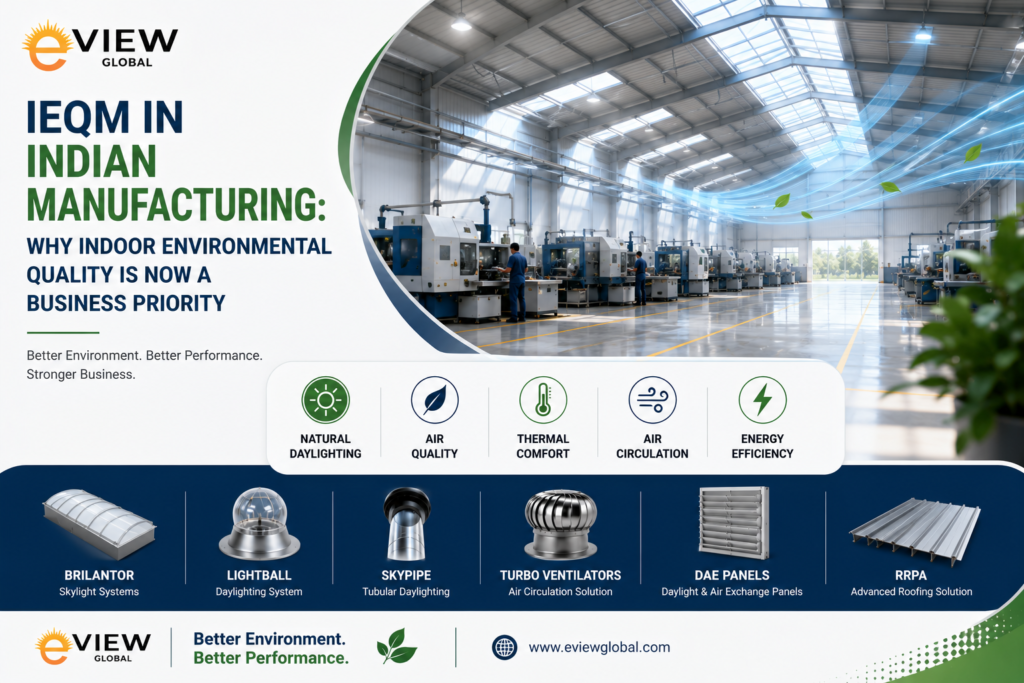
IEQM India | Indoor environmental quality manufacturing | Factory IEQ standards | eView Global
For most of the past three decades, the conversation inside Indian manufacturing facilities centred on one thing: output. How many units per shift. How fast the line runs. How low the cost per piece. The environment inside the factory the quality of the air, the adequacy of the light, the temperature at which workers spent eight or ten hours of their day was largely an afterthought. A background condition. Something managed reactively when it became a problem, not engineered proactively as a competitive asset.
That mindset is changing. And it is changing faster than most facility managers realise. Indoor Environmental Quality Management IEQM is emerging as one of the most consequential operational priorities in Indian manufacturing. It is no longer a concept borrowed from premium office design or Western sustainability frameworks. It is becoming a hard business requirement, driven by export market pressure, ESG disclosure mandates, green building certification targets, workforce retention challenges, and a growing body of evidence linking factory IEQ standards directly to measurable production outcomes.
What IEQM Actually Means in a Factory Context
Indoor Environmental Quality is the measure of how well a building’s internal environment supports the health, comfort, and performance of the people working in it. In industrial buildings, the same principles that have long governed office design apply but the stakes are higher and the baseline is often far worse. IEQM in manufacturing encompasses four primary dimensions:
- Visual quality the adequacy, evenness, and quality of lighting across the workspace. Poor lighting causes eye strain, increases error rates, and creates safety hazards.
- Thermal comfort the internal temperature and humidity level relative to human comfort thresholds. In Indian industrial sheds, internal temperatures routinely exceed outdoor ambient by 8°C to 15°C during peak summer months.
- Air quality and ventilation the rate at which fresh air replaces the internal air volume, measured as air changes per hour (ACH). Adequate ventilation is the primary control for both thermal comfort and respiratory health.
- Acoustic environment noise levels and their management, which affects concentration, communication, and long-term hearing health.
Of these four dimensions, the first three – visual quality, thermal comfort, and air quality – are directly addressable through natural daylighting systems and passive roof ventilation. They are also where most Indian industrial facilities currently perform worst.
Why IEQM Has Become a Business Priority
The Productivity Evidence Is Now Overwhelming
The relationship between indoor environmental quality and worker productivity in manufacturing environments is no longer a matter of educated intuition. It is a documented, quantified relationship. Studies consistently find that inadequate lighting increases error rates and rework. Heat stress above 33°C wet bulb temperature reduces physical output by measurable percentages the WHO has estimated that heat stress already costs India billions in lost productivity annually. Poor ventilation with low ACH increases airborne contaminants and CO2, directly impairing cognitive function and reaction time even at levels below regulatory thresholds.
Conversely, improving IEQM in manufacturing environments has been associated with reductions in absenteeism of 10% to 15%, measurable improvements in quality output, and documented gains in sustained output per worker-hour. For a mid-sized Indian manufacturer running 500 workers across two shifts, even a 5% improvement in effective output per hour represents a substantial commercial gain.
Export Markets Are Demanding It
Indian manufacturers supplying to European, North American, and Japanese buyers face increasing scrutiny of their supply chain environmental and social standards. Factory audits by international buyers now incorporate workplace environmental quality assessments. Poor lighting, excessive heat, and inadequate ventilation are increasingly flagged as findings requiring corrective action. For manufacturers supplying brands with public sustainability commitments – now the majority of significant Western consumer goods companies failure to improve factory IEQ standards is becoming a genuine supply chain risk.
ESG Disclosure Is Bringing It Into the Boardroom
India’s SEBI mandate requiring BRSR (Business Responsibility and Sustainability Reporting) disclosures from the top 1,000 listed companies has changed the governance conversation around workplace environmental quality. BRSR frameworks require companies to disclose data on employee health and safety, workplace conditions, and energy consumption all of which intersect directly with indoor environmental quality. For listed Indian manufacturers, the indoor environment of their factories is no longer just an operational matter. It is a disclosure matter.
Green Building Certification Is No Longer Just for Offices
GRIHA, LEED, and IGBC’s Green Factory Building rating system were once associated primarily with corporate campuses. Over the past five years, industrial facility certifications have grown substantially. Indoor environmental quality is central to all three rating systems. GRIHA explicitly assesses occupant comfort, daylighting provision, and natural ventilation rates. LEED for Industrial Facilities includes credits for daylight access, indoor air quality, and thermal comfort. IGBC Green Factory Building rates daylighting coverage as a percentage of production floor area as a core criterion.
The Factory IEQ Standards Indian Manufacturers Need to Know
- Lighting: BIS under IS 3646 specifies minimum illuminance levels for industrial spaces – generally 150 to 300 lux for general manufacturing areas, with higher requirements for precision work. Many Indian factories fall below these levels in significant portions of their floor area.
- Ventilation: ASHRAE Standard 62.1 and the National Building Code of India specify minimum ventilation rates for occupied industrial spaces. The most meaningful metric for large industrial sheds is ACH ten to twenty air changes per hour through natural ventilation is the target range for effective thermal management in Indian industrial conditions.
- Thermal comfort: ISO 7730 and ASHRAE 55 define operative temperature and humidity ranges for sustained performance. Operative temperatures above 30°C common in poorly ventilated Indian sheds for significant portions of the working day – represent a documented impairment to physical and cognitive output.
Natural Daylighting and Passive Ventilation as the IEQM Foundation
For Indian industrial facilities, the path to measurable IEQM improvement runs primarily through two interventions: natural daylighting and passive roof ventilation. Together, they address three of the four core IEQ dimensions simultaneously visual quality, thermal comfort, and air quality – using zero operational electricity.
Natural daylighting systems eView Global’s Brilantor diffusion panels, LightBall dome units, and SkyPipe tubular skylights – replace artificial lighting during daytime hours with even, glare-free natural illumination that meets or exceeds BIS IS 3646 requirements. Workers gain the visual quality benefits of natural light better colour rendering, reduced flicker, circadian rhythm support that artificial lighting cannot replicate regardless of its energy efficiency.
Turbo ventilators at the roof ridge, combined with DAE Panels at wall and eave level, create a continuous natural convection cycle achieving 10 to 20 ACH without electrical energy. Internal temperatures drop by 5°C to 10°C. Airborne contaminants, heat, humidity, and CO2 are continuously diluted and expelled. The thermal and air quality dimensions of IEQM improve measurably with a documented return on investment that typically runs to 3x to 5x the initial installation cost over the system’s 20-year service life.
IEQM Is Infrastructure, Not a Perk
The most important reframe for Indian manufacturers approaching IEQM for the first time is this: indoor environmental quality is not a welfare initiative or a sustainability gesture. It is operational infrastructure as fundamental to manufacturing performance as the machinery on the shop floor.
The factories that treat IEQM as infrastructure will have lower absenteeism, better output quality, stronger ESG disclosures, cleaner audit findings from international buyers, and a more competitive position in green financing markets. The factories that continue to treat it as an afterthought will face rising audit risk, growing workforce retention challenges, and increasing regulatory pressure as India’s industrial environmental standards tighten.
The evidence is in. The regulatory direction is clear. The business case is documented. IEQM in Indian manufacturing is no longer a question of whether it is a question of when, and how fast.