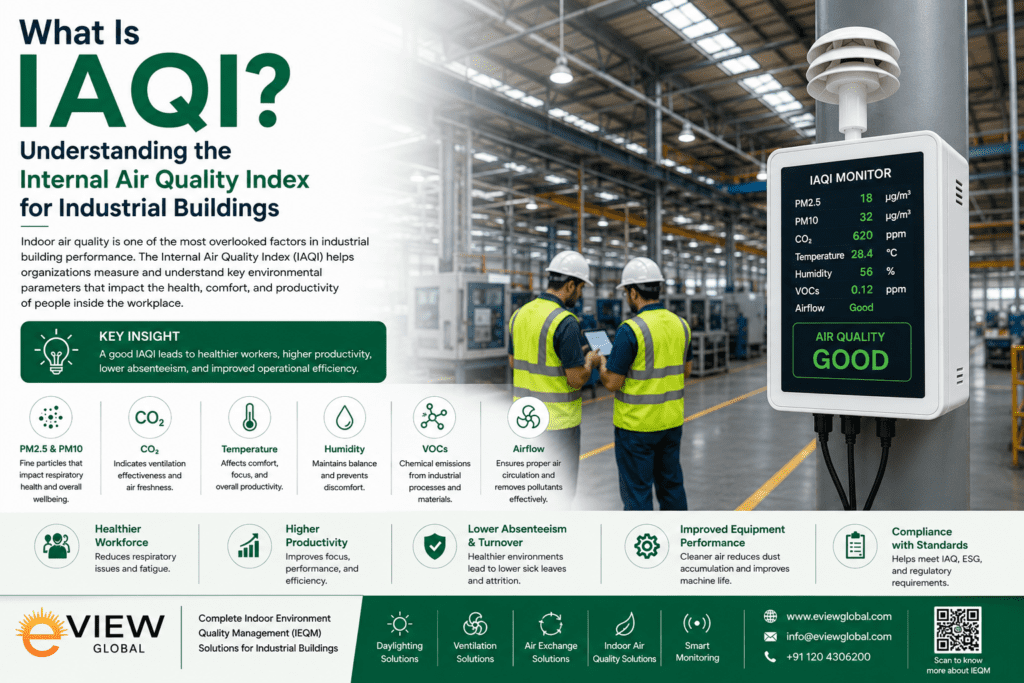
Most industrial facilities focus heavily on production efficiency, machinery performance, energy consumption, and operational output. However, one critical factor that directly affects worker health, productivity, and overall workplace performance often goes unnoticed—indoor air quality.
Employees in factories, warehouses, logistics centers, and manufacturing plants spend long hours inside industrial buildings. If the air quality within these facilities is poor, workers may experience fatigue, discomfort, respiratory issues, reduced concentration, and lower productivity. Over time, poor indoor environmental conditions can also increase absenteeism, operational inefficiencies, and maintenance costs.
This is where the Internal Air Quality Index (IAQI) becomes an important measurement tool. IAQI helps organizations evaluate the quality of air inside a building and identify environmental factors that may affect workers, equipment, and operations.
What Is IAQI?
The Internal Air Quality Index (IAQI) is a framework used to measure and assess the quality of air inside a building. Similar to how the Air Quality Index (AQI) measures outdoor pollution levels, IAQI focuses specifically on indoor environments.
The purpose of IAQI is to provide a measurable understanding of indoor environmental conditions. It evaluates multiple factors that influence workplace health, comfort, and performance, including airborne pollutants, temperature, humidity, ventilation effectiveness, and air circulation.
For industrial facilities, IAQI serves as a key performance indicator because it provides valuable insights into how healthy and efficient the indoor environment truly is. A healthy IAQI generally indicates that workers are operating in an environment with adequate ventilation, acceptable pollutant levels, and comfortable environmental conditions. A poor IAQI often signals environmental issues that require attention.
Why IAQI Matters in Industrial Buildings
Industrial facilities face unique environmental challenges that differ significantly from commercial offices or residential spaces. Manufacturing operations, material handling processes, welding activities, chemical applications, packaging operations, and industrial equipment all contribute to indoor environmental conditions. These activities often generate heat, dust, fumes, airborne particles, and chemical emissions. Without effective ventilation and air circulation, these contaminants accumulate inside the facility.
Poor indoor air quality can result in:
Maintaining a healthy IAQI helps organizations create safer and more productive workplaces while supporting sustainability and operational efficiency goals.
What Parameters Does IAQI Measure?
IAQI evaluates multiple environmental factors that influence indoor air quality.
Particulate Matter (PM2.5 & PM10)
Microscopic particles suspended in the air from industrial processes like grinding, cutting, packaging, vehicle movement, material handling, and construction work.
Monitoring particulate matter levels is one of the most important aspects of IAQI management.
Carbon Dioxide (CO2)
Used as a primary indicator of ventilation efficiency. When fresh outdoor air is inadequate, elevated CO2 levels accumulate, contributing to drowsiness, mental fatigue, reduced concentration, and lower productivity.
Temperature
Industrial facilities often face extreme heat buildup caused by machinery operation, solar heat gain, roofing systems, and heavy manufacturing processes. Excessive temperatures accelerate worker fatigue.
Humidity
Influences both human comfort and equipment longevity. High humidity encourages mold growth and uncomfortable dampness, while extremely low levels trigger respiratory dryness and skin irritation.
Volatile Organic Compounds (VOCs)
Chemical emissions released by paints, adhesives, solvents, coatings, and chemical processes. High VOC concentrations lead to headaches, dizziness, eye irritation, and major respiratory discomfort.
Airflow and Ventilation
Proper air patterns prevent pollutants, moisture, and heat from pooling. Poor ventilation creates stagnant air zones and unpredictable indoor microclimates across the factory floor.
Common Causes of Poor IAQI in Factories
Several factors contribute to poor indoor air quality in industrial facilities, and many facilities experience multiple challenges simultaneously:
How Poor IAQI Affects Workers
Workers are directly affected by indoor environmental conditions across three core dimensions:
1. Health Impacts
Poor indoor air quality can contribute to respiratory irritation, eye discomfort, headaches, fatigue, allergic reactions, and general discomfort. Long-term exposure to unhealthy environments may increase occupational health risks.
2. Productivity Impacts
Research consistently shows that workers perform better in environments with healthy air quality and effective ventilation. Poor IAQI often results in reduced concentration, lower efficiency, increased mistakes, and slower response times, significantly lowering operational performance.
3. Employee Retention Impacts
Employees are more likely to remain with organizations that prioritize workplace wellbeing. Improving indoor environmental conditions often contributes to higher job satisfaction and improved workforce retention.
Operational Risks of Poor IAQI
Poor IAQI affects more than human capital; it ripples into mechanical and corporate health:
- Equipment Performance: Dust and airborne contaminants can accumulate on machinery, reducing efficiency and increasing maintenance requirements.
- Product Quality: Certain industries require strictly controlled environmental conditions to maintain product quality. Poor air quality may compromise manufacturing consistency and quality standards.
- Maintenance Costs: Facilities with poor IAQI often experience increased cleaning and asset maintenance requirements due to dust accumulation and environmental stress.
- Compliance Risks: Environmental regulations and workplace safety standards continue to evolve. Organizations that fail to maintain healthy indoor environments may face compliance challenges and penalties.
How IAQI Is Measured
Assessing IAQI involves monitoring multiple environmental parameters using specialized equipment. Typical measurement strategies aggregate numbers for PM2.5 and PM10 levels, CO2 concentrations, temperature, humidity, VOC levels, and airflow performance. Environmental assessments provide valuable baseline data and help organizations track improvement initiatives over time.
IAQI and Sustainability Goals
Sustainability is becoming increasingly important across industrial sectors. Improving IAQI supports sustainability initiatives by enhancing energy efficiency, supporting employee wellbeing, reducing environmental impact, improving workplace performance, and directly contributing to ESG objectives. Organizations focused on long-term sustainability often include IAQI management within their environmental strategies.
IAQI and Indoor Environment Quality Management (IEQM)
IAQI is a critical component of Indoor Environment Quality Management (IEQM). While IEQM focuses on creating healthier indoor environments through integrated environmental solutions, IAQI provides measurable insights into environmental performance. A strong IAQI score generally indicates effective daylighting, ventilation, air circulation, and thermal management systems working in unison.
How Industrial Solutions Improve IAQI
How Industrial Ventilation Improves IAQI
Ventilation is one of the most effective methods for improving indoor air quality. Industrial ventilation systems help remove stale air, extract pollutants, reduce heat buildup, improve fresh air circulation, and maintain healthier environmental conditions, playing a direct role in improving IAQI scores.
How Natural Daylighting Improves IAQI
Natural daylighting contributes to healthier indoor environments by reducing dependence on artificial lighting and supporting worker wellbeing. Key benefits include improved visual comfort, reduced energy consumption, lower heat generation from lighting systems, and an enhanced workplace experience. Daylighting systems form an important part of modern IEQM strategies.
How Air Exchange Systems Improve IAQI
Daylight and Air Exchange (DAE) Panels combine natural lighting with fresh air movement. These systems help improve ventilation, increase fresh air availability, enhance daylight penetration, and support healthier indoor environments. As a result, DAE Panels contribute directly to improved IAQI performance.
How eView Global Helps Improve IAQI
eView Global specializes in Indoor Environment Quality Management solutions designed to improve indoor environmental conditions in industrial and commercial facilities. Our core ecosystem of architectural and environmental hardware systems includes:
Together, these integrated systems maximize daylighting, ventilation, and air circulation while supporting healthier IAQI levels and drastically reducing energy consumption metrics.
Frequently Asked Questions
A good IAQI indicates healthy indoor environmental conditions characterized by minimal pollutant concentrations and highly effective, fresh air ventilation parameters.
Factories constantly generate particulate dust, excessive structural heat, chemical fumes, and airborne contaminants that break down worker health and drop physical productivity if left unchecked.
Regular, systematic monitoring intervals are recommended to proactively identify micro-environmental issues and continuously maintain baseline safety compliance.
Yes. Engineered ventilation actively flushes built-up atmospheric pollutants, dampens internal heat accumulation, and pulls high volumes of fresh outdoor air into the facility footprint.