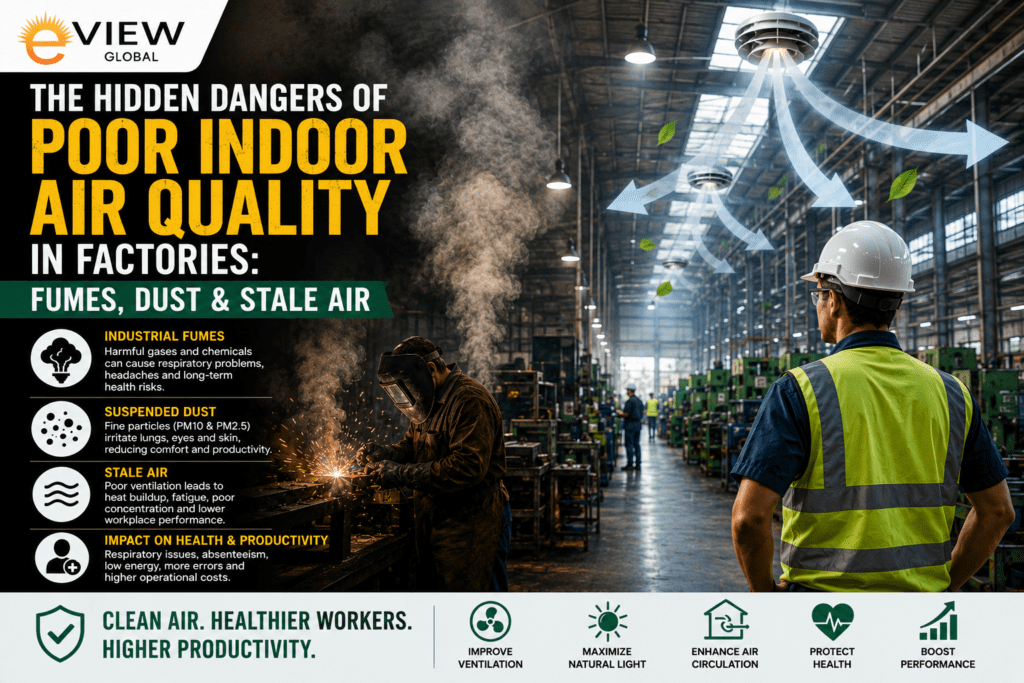
Industrial facilities are designed to maximize production, efficiency, and operational output. However, one critical factor often goes unnoticed until it begins affecting worker health, productivity, and operational performance: indoor air quality.
Inside factories, warehouses, foundries, manufacturing plants, and processing facilities, workers spend long hours exposed to airborne contaminants, industrial fumes, suspended dust particles, excessive heat, and poorly circulated air. While these conditions may seem like a normal part of industrial operations, prolonged exposure can create significant health risks and negatively impact business performance. Poor indoor air quality is not just a workplace comfort issue—it is an operational challenge that affects employee wellbeing, absenteeism, productivity, equipment performance, and overall workplace efficiency.
Understanding Indoor Air Quality in Industrial Buildings
Indoor Air Quality (IAQ) refers to the condition of air inside a building and its impact on the health, comfort, and performance of occupants. In industrial environments, air quality is influenced by various factors including:
When these pollutants accumulate inside a facility without proper ventilation and air exchange, the working environment becomes increasingly unhealthy.
The Problem of Suspended Dust Particles
Dust is one of the most common air quality challenges faced by industrial facilities. Activities such as grinding, cutting, polishing, material handling, packaging, cement processing, woodworking, and metal fabrication continuously generate airborne particles. Many of these particles remain suspended in the air for extended periods before eventually settling on surfaces. The most concerning particles are PM10 and PM2.5, which are small enough to be inhaled deep into the respiratory system.
Excessive dust exposure can contribute to:
Dust accumulation can also affect machinery, electrical systems, and product quality, leading to increased maintenance requirements and operational inefficiencies.
The Hidden Risk of Foundry and Industrial Fumes
Foundries, metal processing facilities, welding operations, and manufacturing plants often generate fumes that are invisible to the naked eye. These fumes may contain fine particles, gases, and chemical compounds released during industrial processes.
Common sources include:
- Welding operations
- Metal casting
- Furnace operations
- Heat treatment processes
- Chemical manufacturing
- Painting and coating activities
Without adequate ventilation, these contaminants remain trapped within the building and continue circulating throughout the workspace. Workers exposed to industrial fumes often experience:
The Impact of Stale Air in Industrial Facilities
While dust and fumes are often visible concerns, stale air is a hidden problem that affects many industrial buildings. Stale air develops when fresh outdoor air is not effectively introduced into the facility and contaminated indoor air is not removed efficiently.
Common causes include:
- Inadequate ventilation systems
- Closed building structures
- Poor airflow design
- Lack of natural air exchange
- Heat accumulation beneath roofing systems
As stale air accumulates, workers may begin experiencing symptoms such as drowsiness, reduced alertness, lower concentration levels, increased fatigue, and general discomfort.
How Poor Indoor Air Quality Affects Worker Health
Employees are the most valuable asset in any industrial operation. Unfortunately, they are also the first to experience the effects of poor indoor air quality. Workers exposed to contaminated indoor environments may face respiratory problems, eye, nose and throat irritation, fatigue, reduced energy levels, increased stress, and physical discomfort.
The Productivity Cost of Poor Air Quality
Poor indoor air quality has a direct impact on operational efficiency. Common productivity impacts include:
- Reduced concentration
- Increased errors
- Slower task completion
- Lower employee morale
- Increased absenteeism
In industries where precision, safety, and efficiency are critical, even small declines in worker performance can significantly affect business outcomes.
Equipment and Operational Challenges
Poor indoor air quality does not only affect people—it also impacts equipment and facility operations. Dust accumulation can reduce machinery efficiency, increase maintenance frequency, affect electrical systems, cause overheating, and shorten equipment lifespan. Similarly, poor ventilation can lead to heat buildup, creating additional strain on both machinery and employees. Maintaining healthy indoor air quality helps protect investments in equipment while supporting operational reliability.
Why Industrial Ventilation Matters
Ventilation is one of the most effective methods for improving indoor air quality. A properly designed industrial ventilation strategy helps remove stale air, extract dust and pollutants, reduce heat buildup, improve air circulation, and introduce fresh outdoor air.
Creating Healthier Industrial Environments
Improving indoor air quality requires a holistic approach that combines ventilation, daylighting, airflow management, and environmental monitoring. Modern industrial facilities increasingly adopt Indoor Environment Quality Management (IEQM) strategies to address these challenges. Solutions such as Turbo Ventilators, Daylight and Air Exchange (DAE) Panels, Natural Daylighting Systems, and Air Circulation Solutions help improve indoor environmental conditions while reducing dependence on energy-intensive systems.
How eView Global Helps Improve Indoor Air Quality
eView Global specializes in Indoor Environment Quality Management (IEQM) solutions designed to improve air quality, natural daylighting, ventilation, thermal comfort, and workplace performance. Through solutions such as Brilantor, LightBall, SkyPipe, Turbo Ventilators, and DAE Panels, industrial facilities can create healthier, brighter, and more productive environments for their workforce. By addressing dust, fumes, stale air, and ventilation challenges, organizations can enhance employee wellbeing, improve operational efficiency, and build more sustainable industrial facilities.