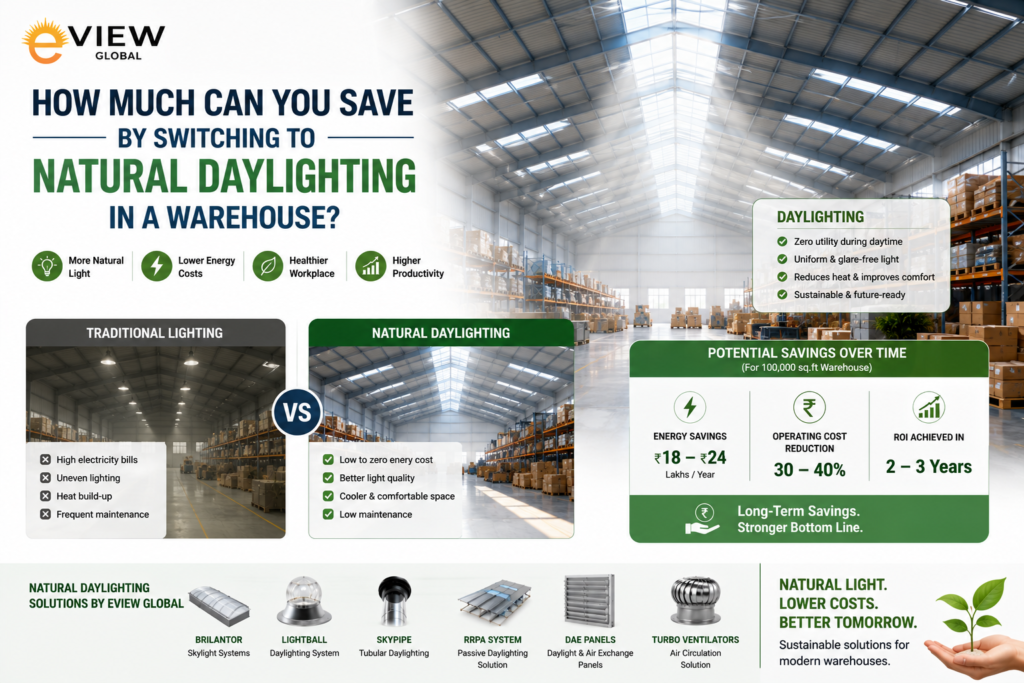
Let’s skip the vague promises and get straight to the numbers.
Every week, warehouse managers and facility heads across India sit across from lighting vendors who talk about “significant savings” and “dramatic reductions” without ever showing a rupee figure. This blog does the opposite. It breaks down exactly what natural daylighting costs, what it saves, and what a realistic return on investment looks like for an Indian warehouse with actual numbers you can take into a board meeting.
What You Are Actually Spending on Warehouse Lighting
A typical Indian warehouse of 50,000 square feet uses between 80 and 120 high-bay LED fittings. Each fitting draws between 150W and 200W. Run those for 10 hours a day, 300 days a year, at an average industrial electricity tariff of ₹8 per kWh:
- 100 fittings x 175W average = 17.5 kW total load
- 17.5 kW x 10 hours x 300 days = 52,500 kWh per year
- 52,500 kWh x ₹8 = ₹4,20,000 per year on lighting alone
That is over four lakh rupees every year – just on lights – in a warehouse that has perfectly good sunlight available for free, eight to ten hours a day, for all 300 of those days. Many warehouses spend significantly more, with older fittings drawing 250W to 400W and tariffs closer to ₹9 to ₹10 per kWh in several industrial zones.
What Natural Daylighting Does to That Number
A properly designed natural daylighting system using diffusion-technology panels like Brilantor or dome-style units like LightBall – replaces artificial lighting during all daytime operational hours in the zones it covers. Not supplements it. Replaces it.
Target lux levels of 200 to 300 lux at floor level – adequate for warehousing, picking, and logistics operations are fully achievable through natural daylighting alone. In our 50,000 square foot example, a Brilantor daylighting installation covering 80% of the floor area changes the consumption picture dramatically:
- Daytime lighting load reduced from 17.5 kW to approximately 3.5 kW
- Annual consumption drops from 52,500 kWh to approximately 10,500 kWh
- Annual saving: 42,000 kWh x ₹8 = ₹3,36,000 per year
Over three lakh rupees. Saved annually. Every year. From one intervention.
The ROI Calculation: When Does It Pay Back?
A quality Brilantor daylighting installation across a 50,000 square foot warehouse typically costs ₹8 to ₹15 lakhs depending on roof type, panel count, and site complexity. Using a mid-range installation cost of ₹12 lakhs:
Simple payback = 12,00,000 / 3,36,000 = approximately 3.6 years
After that payback point, the system generates over three lakh rupees in savings every single year with zero fuel cost, zero moving parts, and minimal maintenance for the next 15 to 20 years of its service life. Total value generated over a 20-year system life at current tariffs: ₹67,20,000. Against an initial investment of ₹12 lakhs. That is a return of more than 5x without accounting for electricity tariff escalation, which has averaged 5% to 8% annually in most Indian states over the past decade.
The Hidden Savings Most Warehouses Never Calculate
Beyond the straight power bill reductions, several latent benefits contribute directly to your bottom line:
- Reduced cooling load: High-bay lighting fittings generate heat as a byproduct. Switch those lights off during the day and the internal temperature drops reducing the runtime of fans, evaporative coolers, or air conditioning systems. This secondary energy saving is real and measurable.
- Lower maintenance costs: Every artificial light fitting has a service life and requires periodic replacement. Natural daylighting panels have a service life of 20+ years with no electrical components to fail or replace. The maintenance cost of a daylighting system, once installed, is effectively zero.
- Carbon and ESG value: The verifiable reduction in electricity consumption has financial value beyond the tariff saving. Eliminating 42,000 kWh of annual consumption represents over 29 tonnes of CO2 equivalent per year – strengthening sustainability reports and supporting access to green financing at preferential rates.
- BEE compliance improvement: For warehouses under BEE’s PAT scheme, improving Specific Energy Consumption directly contributes to compliance targets and the potential to earn tradeable Energy Saving Certificates (ESCerts).
Why Natural Daylighting Outperforms LED Upgrades on Long-Term ROI
A common question from facility managers is: “We already switched to LED haven’t we solved this?” The answer is: partially, not fully. LED lighting is more efficient than older alternatives. However, LEDs still consume electricity, still generate heat, still need replacement, and still add to your electricity bill every hour they run.
Natural daylighting eliminates the daytime lighting electricity cost entirely not reduces it, eliminates it. The comparison is not LED versus natural daylighting; it is electricity cost versus zero electricity cost during daylight hours. Over a 20-year period, that difference is enormous.
Furthermore, natural light quality is genuinely superior for worker wellbeing. Research shows that natural light improves alertness, reduces eye strain, and supports the circadian rhythms that govern energy levels and mood – delivering measurable benefits to picker accuracy, forklift safety, and sustained output alongside the financial ones.
What Determines Your Specific Saving
Every warehouse is different. The actual saving depends on several site-specific variables:
- Current lighting load and hours of operation
- Existing tariff rate and applicable demand charges
- Roof structure, pitch, and available daylighting area
- Operational shift pattern – single shift, double shift, or 24-hour
- Any existing partial daylighting provision
This is why eView Global’s process starts with a detailed site assessment measuring current consumption, mapping lux levels, assessing roof structure, and producing a project-specific savings projection with a documented payback calculation before any installation decision is made.
The Bottom Line
Switching to natural daylighting in a warehouse is not an environmental gesture. It is a commercial decision with a documented, calculable return. For a typical 50,000 square foot Indian warehouse: over three lakh rupees saved annually, a payback period of three to four years, and a 20-year lifetime return that multiplies the original investment several times over – while reducing carbon emissions, improving worker wellbeing, and strengthening ESG credentials.
The sunlight is already there. Every day your warehouse lights are running during daylight hours, you are paying for something you could be getting for free.