Sustainability ESG, carbon footprint, green certifications, BEE compliance | eView Global
India’s industrial sector is at a turning point. Decarbonisation is no longer a distant regulatory obligation or a checkbox on a sustainability report – it is becoming a genuine operational priority for manufacturers, warehouse operators, and facility managers across the country. Export customers in Europe and North America are demanding verified emissions data from their Indian suppliers. Parent companies with global ESG commitments are cascading carbon reduction targets down to their Indian subsidiaries. The Bureau of Energy Efficiency is tightening its Perform, Achieve and Trade (PAT) scheme requirements. And green building certification bodies GRIHA, LEED, IGBC – are seeing record numbers of industrial applicants.
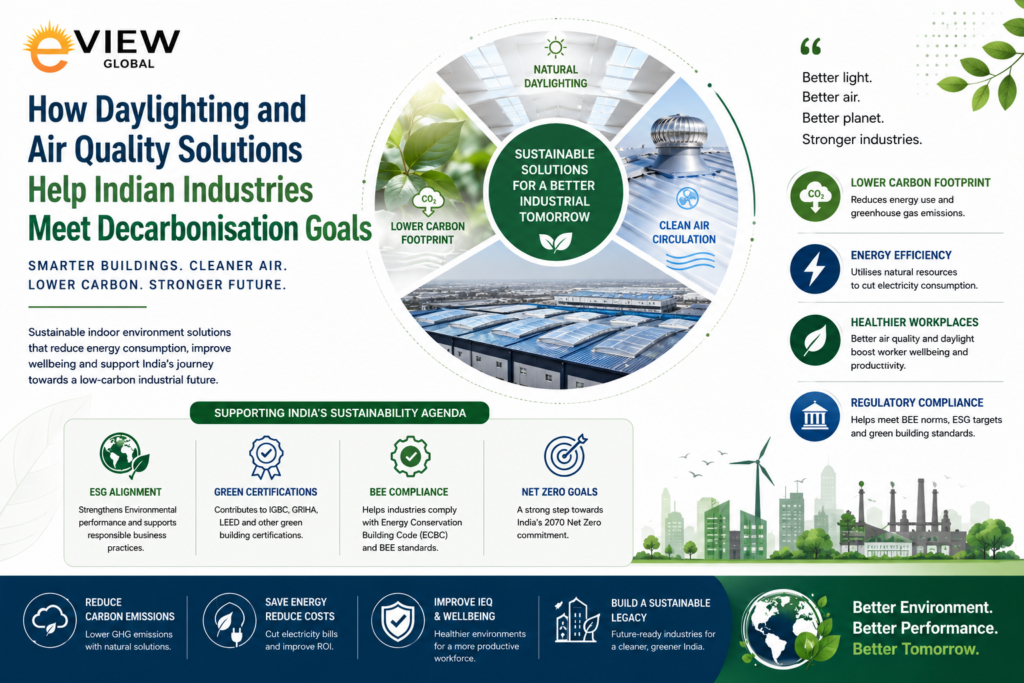
At the centre of all this pressure sits a straightforward question: where does an Indian industrial facility actually begin its decarbonisation journey? For most factories and warehouses, the answer begins on the roof. Natural daylighting solutions and passive air circulation systems the core of what eView Global delivers are among the most direct, measurable, and cost-effective tools available to Indian industries pursuing decarbonisation goals, ESG compliance, BEE targets, and green building certification.
The Carbon Cost of Lighting and Cooling in Indian Factories
In a typical Indian industrial shed running a single shift, artificial lighting accounts for 30% to 40% of total electricity consumption. Add mechanical ventilation and cooling – fans, evaporative coolers, or air conditioning in temperature-sensitive zones and the combined energy draw from lighting and thermal management can represent 50% to 60% of a facility’s total electricity bill.
India’s electricity grid still carries a significant carbon intensity. As a result, every unit of electricity consumed by an industrial building directly contributes to its Scope 2 carbon emissions the emissions generated by the energy a company purchases and uses. For Indian manufacturers supplying to international buyers with Scope 3 emissions reporting requirements, this matters enormously. BEE’s Specific Energy Consumption (SEC) benchmarks under the PAT scheme set sector-specific targets that many energy-intensive industries are actively working to meet. Reducing electricity consumed by lighting and ventilation through passive, zero-energy alternatives is therefore a direct and verifiable carbon reduction strategy.
How Natural Daylighting Reduces Scope 2 Emissions
Natural daylighting systems Brilantor panels, LightBall dome diffusers, and SkyPipe tubular skylights eliminate the need for artificial lighting during all daytime operational hours in the zones they serve. A well-designed daylighting installation delivers target lux levels at workstation height – typically 200 to 500 lux using zero electrical energy.
For a facility running 300 working days a year on a single 8-hour daytime shift, this means eliminating up to 2,400 hours of high-bay lighting operation annually. A 10,000 square foot warehouse zone with high-bay LED lighting consuming 15 kW eliminates 36,000 kWh of electricity per year through full daylighting replacement. At India’s average grid carbon intensity of approximately 0.71 kg CO2 per kWh, this represents a reduction of over 25 tonnes of CO2 equivalent per year from a single zone alone. Scale that across a multi-bay industrial campus and the numbers become significant very quickly.
Because natural daylighting systems are entirely passive no motors, no electrical components, no scheduled replacements the carbon saving is permanent and cumulative over the system’s 20+ year service life. The carbon reduction is real, recurring, and fully verifiable for ESG reporting purposes.
How Passive Ventilation Supports Decarbonisation
The relationship between ventilation and carbon emissions is less obvious than lighting but equally important. In facilities where mechanical cooling or powered exhaust systems are running to manage internal temperatures, every hour of reduced mechanical operation translates directly into electricity savings and emission reductions.
eView Global’s turbo ventilators create a continuous natural convection cycle drawing hot air out at the roof ridge while DAE Panels at wall or eave level allow fresh ambient air to enter below. This convection loop, driven entirely by wind energy and thermal buoyancy, achieves 10 to 20 air changes per hour in a well-designed installation. Internal temperatures drop by 5°C to 10°C against the baseline. In many facilities, this temperature reduction eliminates the need for mechanical cooling entirely during moderate weather, and substantially reduces mechanical cooling runtime during peak summer months producing a measurable reduction in Scope 2 emissions and improved BEE SEC performance.
ESG Reporting: Making Decarbonisation Visible and Verifiable
For Indian industries operating under ESG frameworks driven by corporate policy, investor requirements, export customer mandates, or SEBI’s BRSR (Business Responsibility and Sustainability Reporting) requirements daylighting and passive ventilation systems offer a particularly valuable attribute: their impact is easily quantifiable and independently verifiable.
Baseline electricity consumption before installation is measured and recorded. Post-installation consumption is measured and compared. The reduction in kWh directly translates to a CO2 equivalent reduction using published grid emission factors. This makes eView Global’s solutions well-suited to GRI Standards, BRSR disclosures, and CDP (Carbon Disclosure Project) submissions providing genuine, auditable Scope 2 reductions that strengthen a company’s sustainability narrative with the hard data that reporting frameworks require.
Green Building Certification: Earning Credits Through Daylighting and Ventilation
Natural daylighting and passive ventilation systems contribute directly to multiple scoring criteria across India’s leading green building frameworks:
- GRIHA: Daylighting solutions contribute to Site Planning and Design as well as Energy Performance criteria specifically the reduction of artificial lighting load and improvement of occupant visual comfort. Natural ventilation contributes to Indoor Environment Quality criteria, particularly air change rates and thermal comfort.
- LEED for Industrial Facilities: Natural daylighting earns credits under Indoor Environmental Quality Daylight category. Passive ventilation supports credits under Energy and Atmosphere through reduction of mechanical system energy consumption, and under Indoor Environmental Quality through improved ventilation rates.
- IGBC Green Factory Building: This system, specifically designed for Indian manufacturing facilities, includes direct credits for daylighting coverage as a percentage of production floor area, natural ventilation provision, and overall energy reduction against a baseline all of which eView Global’s solutions directly address.
Beyond the certification credits, eView Global’s project documentation – lux measurements, ACH calculations, energy consumption baselines and post-installation comparisons – provides the precise data that certification assessors require. Clients pursuing GRIHA or LEED find that this documentation significantly accelerates the evidence-gathering process.
BEE Compliance and the PAT Scheme
The Bureau of Energy Efficiency’s Perform, Achieve and Trade (PAT) scheme sets mandatory Specific Energy Consumption reduction targets for energy-intensive industries across sectors including cement, aluminium, steel, fertilisers, textiles, and pulp and paper. Facilities that fail to meet their SEC reduction targets face financial penalties; those that exceed targets earn tradeable Energy Saving Certificates (ESCerts).
Reducing artificial lighting consumption and mechanical ventilation load through passive daylighting and natural air circulation directly improves a facility’s SEC performance the energy consumed per unit of production output. For PAT-designated facilities, investment in natural daylighting and passive ventilation therefore generates measurable progress toward mandatory BEE compliance targets and, where targets are exceeded, the opportunity to generate ESCerts with tradeable value.
The Business Case: Decarbonisation That Pays for Itself
One persistent myth about sustainability investment is that it comes at a cost to commercial performance. Natural daylighting and passive ventilation systems are among the clearest counterexamples to this myth in the industrial built environment.
The electricity savings generated by eliminating artificial lighting and reducing mechanical ventilation load produce a measurable return on investment typically within 3 to 5 years for a well-designed installation, with the system continuing to generate savings for the remaining 15+ years of its service life. The carbon reductions are real and verifiable. The ESG reporting benefits are genuine. The green certification credits are earned. BEE SEC performance improves directly.
eView Global’s 1,540+ completed projects across Indian industry from Bajaj and Tata Motors to Bosch, Mahindra, Aditya Birla, and Godrej – represent a cumulative body of evidence that passive daylighting and ventilation solutions deliver on all of these dimensions simultaneously. Not as a trade-off between sustainability and commercial performance, but as a strategy that advances both at the same time.
Starting Your Decarbonisation Journey
For most Indian industrial facilities, the path to measurable decarbonisation does not begin with renewable energy installations, fleet electrification, or process redesign. It begins with a site assessment that identifies exactly how much electricity is being consumed by lighting and thermal management and how much of that can be eliminated through passive daylighting and natural air circulation. That assessment is where eView Global’s engagement process starts. The result is a building-specific solution that delivers verified carbon reductions, strengthens ESG reporting, supports green certification goals, and improves BEE PAT performance from day one of commissioning.