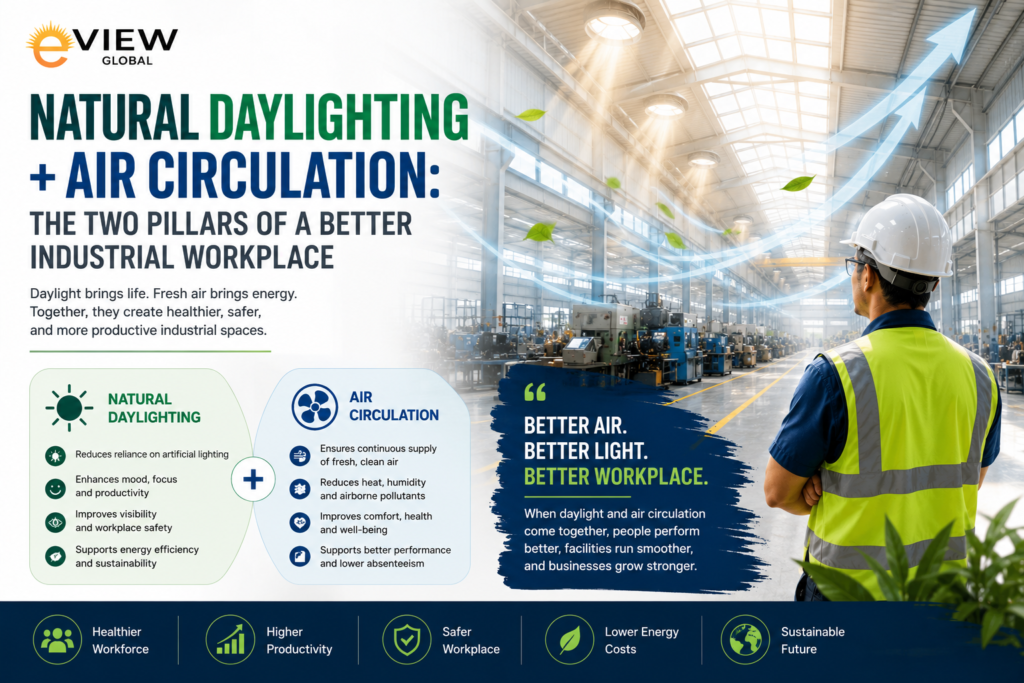
Walk into most Indian industrial sheds or warehouses during the afternoon and you will notice two things almost immediately – dim, yellowed artificial lighting and stifling heat. Workers sweat through shifts under fluorescent lights that barely cut through the haze, while roof-mounted exhaust fans struggle to push out heat that has been building since morning. This is not just a comfort problem. It is a productivity problem, a health problem, and a significant operational cost problem.
The solution, however, is not complicated. It comes down to two fundamental elements: natural daylighting and natural air circulation. When these two forces are engineered to work together inside an industrial building, the result is what experts now call a high-quality Indoor Environmental Quality Management (IEQM) environment a workplace where people perform better, materials last longer, and energy bills shrink dramatically.
Why Industrial Workplaces Struggle With Light and Heat
Industrial buildings – factories, warehouses, logistics hubs, manufacturing plants share a common design challenge. They tend to be large, deep-footprint structures with metal or concrete roofs that absorb heat rapidly. Side windows, when present, only illuminate the perimeter. The interior remains dark regardless of how bright the sun is outside.
The conventional answer has been artificial industrial lighting – high-bay LED or fluorescent fixtures running for 8 to 12 hours a day. This solves the visibility problem but adds substantially to electricity consumption. In a large warehouse, lighting can account for 30% to 40% of total energy usage.
Heat compounds the problem. Metal roofs conduct and radiate heat downward throughout the day. Without proper roof ventilation, internal temperatures in Indian industrial sheds can exceed outdoor temperatures by 8°C to 15°C. This forces workers to slow down, increases the risk of heat stress, accelerates equipment wear, and pushes up cooling costs.
Natural Daylighting: Bringing the Sun Inside, Without the Heat
Modern natural daylighting solutions do something remarkable – they bring abundant sunlight into deep industrial interiors while filtering out the heat and glare that make direct sunlight problematic. Systems like Brilantor daylighting panels, LightBall diffusers, and SkyPipe tubular skylights are engineered specifically for industrial and commercial roofs. Unlike old-style transparent polycarbonate sheets that turned spaces into greenhouses, these advanced systems use multi-layer diffusion technology to scatter incoming sunlight evenly across the floor area below. The result is bright, consistent, glare-free natural lighting without the thermal load.
The benefits of proper industrial skylights and daylight harvesting go far beyond energy savings:
- Worker Productivity and Well-Being: Research consistently shows that workers in naturally lit environments are more alert, make fewer errors, and report higher job satisfaction. Exposure to natural light regulates circadian rhythms, improves mood, and reduces eye strain caused by flickering artificial sources. For industries where precision matters – pharmaceuticals, auto assembly, food processing – this translates directly to quality outcomes.
- Energy and Cost Savings: A well-designed natural daylighting system can eliminate the need for artificial lighting during all daytime hours in illuminated zones. For a facility running 300 days a year, this represents substantial savings on electricity bills with zero ongoing operational cost, since the best systems are completely passive and maintenance-free with lifespans exceeding 20 years.
- Compliance and Sustainability: Green building certifications, ESG commitments, and evolving industrial safety regulations increasingly factor in indoor environmental quality. Natural daylighting is one of the fastest and most cost-effective ways to move the needle on all three.
Air Circulation: Moving Heat Out Before It Builds Up
Natural lighting addresses visibility. But without addressing heat, you have only solved half the problem. This is where industrial roof ventilation becomes critical. Turbo ventilators – wind-driven or powered roof-mounted units – create a continuous chimney effect. Hot air, which naturally rises, is drawn out through the ventilator at the ridge of the roof. Fresh, cooler ambient air enters through lower openings such as dual-function louvers at the wall or eave level. This creates a natural convection cycle that can exchange the air in an industrial building multiple times per hour without any electricity.
Natural air changes per hour (ACH) is a core metric of industrial indoor environmental quality. A poorly ventilated shed may have an ACH of 1 to 2 – meaning stale, hot air lingers for extended periods. Properly designed roof ventilation systems can achieve ACH rates of 10 to 20 in industrial settings, dramatically reducing heat load, humidity, moisture accumulation, and airborne contaminants.
- Heat Extraction: Turbo ventilators remove the trapped heat that conventional roof materials absorb and radiate downward. Internal temperatures can drop by 5°C to 10°C in well-ventilated sheds, reducing the thermal stress on both workers and equipment.
- Moisture and Condensation Control: Industrial processes often generate humidity. Without adequate air changes, this moisture condenses on structural elements, promoting rust, mould, and material degradation. Continuous natural ventilation keeps moisture levels in check.
- Air Quality: Dust, fumes, chemical vapours, and particulate matter generated by industrial processes need to be continuously diluted and expelled. Natural ventilation achieves this passively, reducing the burden on mechanical filtration systems.
The IEQM Advantage: When Daylighting and Ventilation Work Together
Here is where the real transformation happens. Natural daylighting and air circulation are not simply two separate systems that happen to be installed on the same roof. When designed as an integrated solution, they reinforce each other to create a measurably superior indoor environment.
Consider this: a roof skylight panel and a turbo ventilator can coexist on the same roof structure. The skylight brings daylight in. The ventilator draws hot air out. Together, they address the three fundamental needs of any occupied industrial space – adequate light, acceptable temperature, and clean air – using zero grid electricity. This is the essence of Indoor Environmental Quality Management (IEQM) in industrial buildings. It is not about luxury amenities. It is about engineering the basic physical environment of the workplace to support human performance and health.
Studies on IEQM in manufacturing environments have found that improving IEQ factors can reduce absenteeism by up to 15%, lower error rates, and improve output per worker-hour – numbers that matter enormously at scale. Dual-function louvers further enhance the integration. These systems simultaneously allow controlled daylight entry at wall level while promoting cross-ventilation, giving facility managers the ability to fine-tune both light and airflow without additional infrastructure.
Why Industrial Facility Managers Are Prioritising This Now
The conversation has shifted. Five years ago, most industrial clients approached natural daylighting purely as an energy-saving measure with a simple ROI calculation. Today, the conversations happening in boardrooms and on factory floors are broader. Clients are asking:
- How do we retain skilled workers in competitive labour markets? Better working environments matter.
- How do we meet ESG targets set by parent companies or export customers? Passive systems reduce carbon footprint.
- How do we reduce power grid dependency amid tariff hikes and load-shedding? Zero-energy daylighting and ventilation are the answer.
- How do we achieve green building or GRIHA certification? IEQM improvements are central to scoring.
Natural daylighting through industrial roof skylights and natural air circulation through roof ventilators and louvers are no longer optional add-ons. They are strategic infrastructure.
What a Combined Solution Looks Like in Practice
At Eview Global, the process of delivering an integrated daylighting and air circulation solution begins with a detailed assessment of the building’s roof structure, interior layout, existing lighting load, and operational requirements. Every industrial building is different – the roof pitch, ridge height, internal obstructions, shift timing, and type of industrial activity all influence the optimal system design.
The outcome, however, is consistent: a building where workers arrive in a brighter, cooler, better-ventilated environment. A building where the electricity meter slows down during the day. A building that meets modern standards for indoor environmental quality without sacrificing structural integrity or operational workflow.
With over 15 years of experience, 1,540+ completed projects, and clients ranging from Bajaj and Tata Motors to Bosch and Mahindra, Eview Global has demonstrated that the two pillars of a better industrial workplace – natural daylighting and natural air circulation – are not aspirational concepts. They are deliverable outcomes, available today, with proven returns.