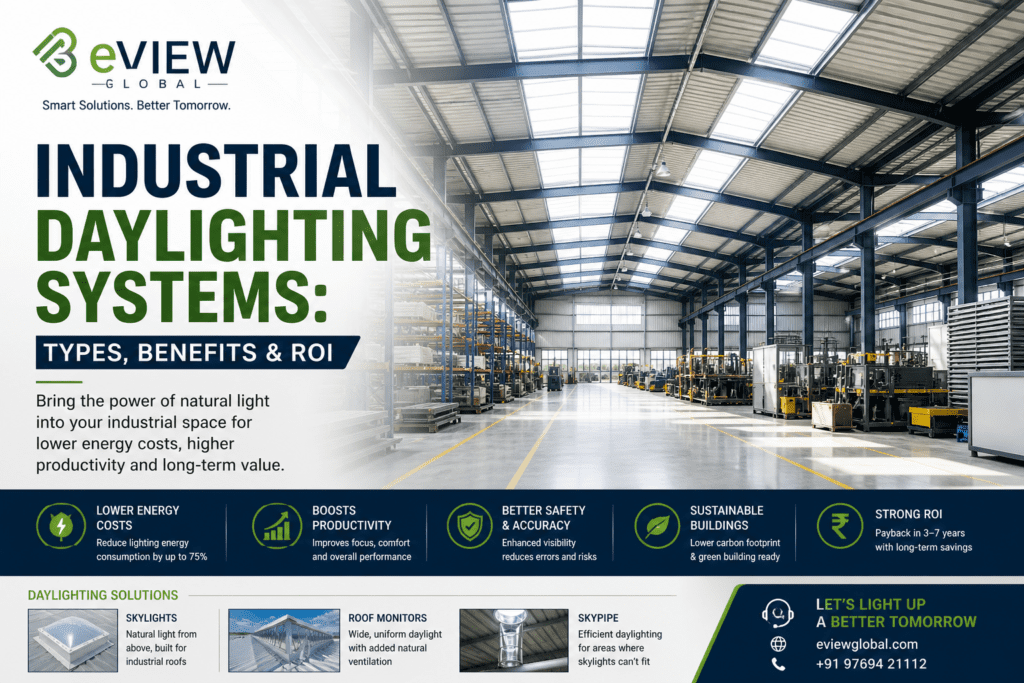
Heat buildup, high electricity bills, and poor working conditions are daily realities in Indian warehouses, factories, and industrial sheds. If your facility depends entirely on artificial lighting, you are spending far more than you need to — and your workers are paying the price in comfort and productivity.
Industrial daylighting systems offer a smarter approach. By bringing controlled natural light into your building, they reduce your dependence on electric lighting, lower operating costs, and create a significantly better environment for your workforce. This guide covers everything you need to know: what these systems are, the types available, their key benefits, and how to evaluate your return on investment.
What Are Industrial Daylighting Systems?
Industrial daylighting systems are architectural and optical solutions that introduce controlled natural light into large commercial or industrial buildings. Unlike standard windows and transparent sheets — which can create glare, heat gain, and security vulnerabilities — daylighting solutions are purpose-engineered for industrial environments.
They work by capturing daylight from the roof or upper walls and distributing it evenly across wide floor areas, typically without direct sun exposure that causes glare or discomfort. A well-designed natural daylighting system balances light quality, thermal performance, and structural integrity to meet the specific operational demands of your facility.
The goal is not to eliminate electric lighting entirely — it is to reduce how often and how intensely you need it.
Types of Industrial Daylighting Systems
The right daylighting solution depends on your building’s structure, roof type, climate, and internal requirements. Here are the main types used across Indian industrial facilities.
1. Skylights and Roof Lights
The most widely used daylighting solution. Fixed or vented panels installed directly into the roof deck allow diffused natural light to enter from above. Skylights are ideal for flat or low-slope roofs and are available in a range of materials including polycarbonate and glass. eView Global’s Brilantor and LightBall skylight systems are specifically engineered for Indian industrial roofs.
2. Roof Monitors
Raised structures running along the ridge of a roof, fitted with vertical glazing on one or both sides. Roof monitors provide uniform, glare-free daylight across wide floor spans and also support natural ventilation — making them a dual-function rooftop solution for large sheds and factories.
3. Tubular Daylighting Devices (TDDs)
Tubular daylighting devices capture sunlight through a rooftop dome, transmit it down a highly reflective tube, and diffuse it into the space below. They are particularly effective in areas where conventional skylights cannot be installed due to structural constraints or tight roof spaces.
4. Clerestory Windows
High-mounted windows positioned above the roofline of an adjacent lower structure. Clerestory windows bring in large volumes of indirect natural light without sacrificing usable wall space at floor level — a common choice for facilities requiring both daylight and storage flexibility.
5. Sawtooth Roof Design
A classic industrial roofing format featuring a series of ridges with vertical glazing on one side. North-facing glazing provides consistent, shadow-free illumination throughout the day — making sawtooth designs a preferred choice for manufacturing environments requiring stable, high-quality light.
6. Daylight Harvesting Systems
Not a physical structure, but a critical control layer. Photosensors and smart dimming controls automatically adjust electric lighting levels in response to available natural light. Daylight harvesting systems work alongside any of the physical daylighting solutions above to maximise energy savings and eliminate manual operation.
Key Benefits of Natural Daylighting Systems
Energy and Cost Reduction
- Lighting accounts for 20–40% of a typical industrial facility’s electricity bill. A properly designed natural daylighting system with daylight harvesting controls can reduce this by up to 75%.
- Reduced lighting also means less heat generated indoors, which lowers the HVAC load — an additional energy saving that many facilities do not initially account for.
- Lower energy consumption reduces your carbon footprint, directly supporting ESG targets and sustainability reporting.
Worker Health and Productivity
- Natural light regulates circadian rhythms, improving alertness, mood, and sleep quality — particularly beneficial for workers on extended or rotating shifts.
- Research consistently shows productivity improvements of 10–20% in daylit work environments. For a production line or warehouse team, this represents a measurable operational gain.
- Reduced eye strain and fewer headaches — common in fluorescent-heavy facilities — mean fewer sick days and a healthier, more engaged workforce.
Safety and Accuracy
- Higher-quality natural light improves colour rendering and depth perception, reducing errors in quality control, assembly, and material handling operations.
- Better-lit work environments consistently record lower rates of accidents and near-misses, particularly around machinery, loading bays, and pedestrian routes.
Sustainability and Compliance
- Industrial daylighting solutions contribute directly towards green building certifications including LEED, BREEAM, and IGBC — increasingly important for attracting tenants, securing financing, and meeting regulatory requirements.
- Many energy efficiency schemes offer incentives, rebates, or accelerated depreciation benefits for qualifying daylighting installations — reducing your effective upfront cost.
Understanding the ROI of Industrial Daylighting Systems
Calculating the return on investment for a daylighting system or daylight harvesting retrofit involves more variables than most facilities initially consider. Here is a structured framework.
1. Direct Energy Savings: Measure your current lighting electricity spend. A well-installed daylighting system with automated controls typically reduces this by 40–75%. Multiply the saved kWh by your tariff rate to arrive at annual rupee savings.
2. HVAC Savings: Every watt of lighting removed also removes heat from the building. In cooling-dominated climates like most of India, this can add 10–20% to your total annual savings figure.
3. Productivity Gains: Even a conservative 5% improvement in output across a 50-person facility can generate significant annual value — often exceeding the energy savings themselves.
4. Maintenance Reduction: Natural light does not burn out. Fewer lamp replacements, less fixture servicing, and reduced electrical maintenance all contribute to lower ongoing operating costs.
5. Payback Period: Most industrial daylighting installations achieve payback in 3–7 years. Available incentives and rebates can shorten this to 2–4 years.
When evaluating daylighting solutions, request energy modelling specific to your building footprint, roof type, and geographic location. Generic estimates rarely reflect the actual performance of a correctly specified and installed system.
Choosing the Right System for Your Facility
There is no universal answer when it comes to industrial daylighting systems. The right solution depends on several factors that should be assessed together.
Building geometry: Roof pitch, span width, and structural load capacity all influence which system types are feasible. A flat-roofed distribution centre and a pitched manufacturing shed will have very different daylighting requirements.
Climate and orientation: Solar angle, cloud cover frequency, and seasonal variation determine how much usable daylight your site receives — and how the system should be designed to account for it.
Internal requirements: Some industrial processes — pharmaceuticals, food manufacturing, electronics assembly — have strict light quality requirements. Your daylighting design must accommodate what happens inside the building, not just the building envelope.
Integration with existing systems: A daylight harvesting system delivers maximum benefit when integrated with LED lighting infrastructure. If your facility still runs older HID or fluorescent fixtures, a combined lighting and daylighting upgrade will typically deliver the strongest ROI.
Frequently Asked Questions
What is a daylight harvesting system?
A daylight harvesting system uses photosensors and automated lighting controls to dim or switch off electric lights when sufficient natural light is available. It works alongside physical daylighting infrastructure — skylights, roof monitors, TDDs — to maximise energy savings without requiring manual management.
Can industrial daylighting be retrofitted into an existing building?
Yes. Many daylighting solutions, including tubular daylighting devices and modular skylight systems, are specifically designed for retrofit applications. A structural and energy assessment is recommended before installation to confirm compatibility and optimise placement.
How much does an industrial daylighting system cost?
Costs vary based on system type, facility size, roof structure, and installation complexity. Most projects qualify for energy efficiency incentives that meaningfully offset upfront costs.
Does natural daylighting cause glare or overheating?
Well-designed natural daylighting systems include diffusing materials, internal baffles, and careful orientation planning to prevent direct sun penetration and glare. Modern systems also incorporate low-emissivity glazing or UV-stabilised polycarbonate to manage solar heat gain.
What maintenance does an industrial daylighting system require?
Most systems require very little maintenance — primarily periodic cleaning of glazing surfaces and occasional inspection of seals and fixings. Compared to electric lighting systems, the maintenance burden over the product lifecycle is substantially lower.
Conclusion
Industrial daylighting systems are one of the highest-impact, lowest-risk investments a facility operator can make. They reduce energy costs from day one, improve working conditions for your team, support sustainability goals, and deliver a strong, calculable return over a lifespan of 15 to 20 years or more.
For warehouses, manufacturing plants, logistics hubs, and large commercial buildings across India, the move to natural daylighting is not just a cost decision — it is a competitive advantage.
Ready to explore daylighting for your facility? Contact eView Global for a free site assessment and customised system recommendation. Visit eviewglobal.com or call +91 97694 21112.