Heat buildup is one of the most persistent operational challenges in Indian warehouses, factories, and industrial sheds. When internal temperatures soar, worker productivity drops, machinery runs hotter, and the overall working environment becomes unsafe. Two of the most common solutions facility managers consider are the turbo ventilator and the electric exhaust fan — but which one is actually better for industrial ventilation?
In this article, we break down the key differences between turbo ventilators and exhaust fans across every metric that matters to industrial operators: energy cost, performance, maintenance, lifespan, and long-term ROI. By the end, you will have a clear picture of which solution is right for your warehouse, factory, or production facility.
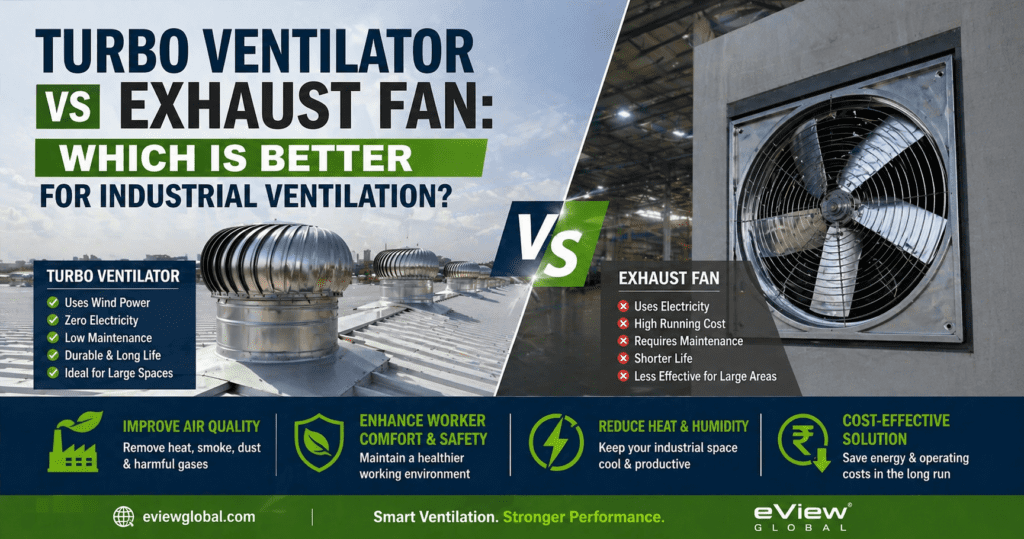
Key insight: A turbo ventilator works 24 hours a day, 365 days a year — using zero electricity. An exhaust fan only works when switched on, and every hour it runs adds to your electricity bill.
What Is a Turbo Ventilator?
A turbo ventilator — also known as a wind-driven roof ventilator or turbo vent — is a passive ventilation device installed on the roof of an industrial building. It operates entirely on wind energy. As outdoor wind passes over the rotating turbine blades, it creates a venturi effect that draws hot, stale air upward and out of the building — continuously and silently, without any electrical input.
eView Global’s turbo ventilators are engineered for Indian industrial conditions, offering:
- Wind-driven and motorised (powered) options for varying wind conditions
- Durable, weather-resistant construction for long-term outdoor performance
- Near-silent operation with no motor vibration or mechanical noise
- Direct reduction in internal temperature by continuously exhausting hot roof-level air
- Compatibility with daylighting systems for a fully integrated rooftop solution
Turbo vents are widely used in warehouses, logistics hubs, manufacturing plants, food processing units, pharmaceutical facilities, and large commercial buildings across India.
What Is an Electric Exhaust Fan?
An electric exhaust fan is a motor-driven fan mounted on walls, roofs, or ceilings to mechanically push or pull air out of a space. It requires a continuous supply of electricity to operate and must be manually or automatically switched on and off.
While exhaust fans are effective for small rooms, low-ceiling spaces, and areas with specific spot-ventilation requirements, they come with significant drawbacks when applied to large-scale industrial ventilation:
- Continuous electricity consumption adds to operational costs every month
- Motors are subject to wear, overheating, and failure — especially in hot industrial environments
- Performance drops to zero during power outages, which are common in many Indian industrial areas
- Large industrial spaces require multiple high-capacity fans, multiplying both cost and maintenance burden
- Motor noise can be disruptive in production and quality-sensitive environments
Turbo Ventilator vs Exhaust Fan: Full Comparison
Key Advantages of Turbo Ventilators for Industrial Roof Ventilation
1. Zero Energy Cost — Every Single Day
This is the defining advantage of industrial roof ventilation using turbo vents. Once installed, a turbo ventilator costs nothing to run. There are no electricity bills, no metered consumption, and no operational cost regardless of how many hours it operates. For large warehouses running 10 to 12 hours a day, the annual energy savings compared to electric exhaust fans can be substantial.
eView Global’s turbo ventilators begin delivering ROI from day one — with no recurring expenditure for the life of the product.
2. Works Through Power Cuts and Grid Failures
Industrial operations in India frequently face grid instability and scheduled outages. An electric exhaust fan stops immediately when power is cut — leaving workers in a hot, poorly ventilated environment. A turbo ventilator, on the other hand, continues working as long as there is any wind movement. This resilience makes turbo vents the dependable choice for uninterrupted industrial ventilation.
3. Continuous Heat Removal at Roof Level
Hot air naturally rises. In large industrial buildings, heat accumulates at roof level — often 8 to 15 degrees Celsius hotter than at floor level. Turbo ventilators are mounted at the highest point of the roof, exactly where this hot air concentrates. They continuously draw this superheated air out of the building throughout the day and night, maintaining a more comfortable and productive working environment below.
This targeted, continuous approach to industrial roof ventilation is far more effective than wall-mounted exhaust fans that work against the natural movement of hot air.
4. Near-Silent Operation
Electric exhaust fans generate motor noise — which compounds across a large facility with multiple units running simultaneously. Turbo ventilators operate silently, with only a gentle rotation driven by wind. This makes them preferable in environments where noise control matters, such as pharmaceutical facilities, precision manufacturing, and quality inspection areas.
5. Minimal Maintenance Over a Long Lifespan
An electric exhaust fan motor requires periodic lubrication, cleaning, and eventual replacement. Bearings wear out. Motors overheat. Blades accumulate dust and lose efficiency. eView Global’s turbo ventilators are built with weather-resistant materials and require virtually no maintenance over a 15 to 20-year operational lifespan — delivering consistent industrial ventilation performance year after year.
6. No Wiring, No Switchboards, No Electrical Infrastructure
Installing exhaust fans in a large warehouse requires electrical wiring, switchboards, circuit breakers, and potentially a dedicated electrical panel. Turbo vents require none of this. They are roof-mounted mechanical devices — no wiring, no electrician, no ongoing electrical compliance requirements. Installation is faster, simpler, and more cost-effective.
When Might an Exhaust Fan Still Make Sense?
To be fair, exhaust fans do have a place in certain scenarios. They are best suited to:
- Small enclosed rooms or offices where roof-mounted ventilation is not feasible
- Areas that require precise airflow control or negative pressure environments
- Situations where local building codes require mechanical ventilation certification
- Spaces with very low ceilings where turbine ventilators cannot be installed
For the vast majority of industrial applications — large floor areas, high-ceiling sheds, warehouses, and open-plan factories — turbo ventilators are the clearly superior and more cost-effective choice.
Combining Turbo Ventilators with Natural Daylighting for Maximum Efficiency
The most energy-efficient industrial buildings in India today use an integrated rooftop strategy: natural daylighting systems for zero-cost illumination combined with turbo ventilators for continuous, zero-cost heat removal. eView Global specialises in delivering exactly this combination.
When roof skylights (like Brilantor or LightBall) are installed alongside turbo vents, the result is a facility that operates throughout the day with near-zero electrical dependency for both lighting and ventilation — delivering dramatic reductions in operating costs and a significantly better working environment for staff.
“By integrating roof ventilators, roof skylights, and natural lighting, we achieved both better ventilation and illumination without extra power usage.” — Sachin Das, Multi-Utility Industrial Unit
Why eView Global for Industrial Ventilation?
eView Global has delivered industrial roof ventilation solutions to 1,540+ projects across India, serving clients including Bajaj, Tata Motors, Bosch, Godrej, and Mahindra. Their turbo ventilators are available in wind-driven and powered configurations to suit different building layouts and local wind conditions.
Every installation is customised to the specific building structure, roof type, internal volume, and ventilation requirement — ensuring optimal airflow performance rather than a generic, one-size-fits-all approach.
- 15+ years of industrial ventilation expertise
- Durable, weather-resistant turbo vent construction
- Wind-driven and motorised options available
- Can be paired with dual-function louvers for enhanced air control
- Integrated solutions combining daylighting and ventilation
- Full site assessment and installation support
Conclusion: For Industrial Ventilation, the Turbo Ventilator Wins
When it comes to industrial ventilation for warehouses, factories, sheds, and large commercial buildings, the turbo ventilator outperforms the electric exhaust fan on virtually every metric. It costs nothing to run, works through power outages, removes heat continuously from the hottest part of the building, requires minimal maintenance, and delivers a 15 to 20-year lifespan — all without a single unit of electricity.
For facility managers and industrial owners looking to reduce operating costs, improve worker comfort, and build a more sustainable operation, industrial roof ventilation using eView Global’s turbo vents is the clear, proven choice.
Ready to upgrade your industrial ventilation? Contact eView Global for a free site assessment and custom turbo ventilator recommendation. Visit eviewglobal.com or call +91 97694 21112.